


10 proven ways to boost employee motivation — practical strategies to elevate engagement, productivity, and workplace satisfaction.
1. Improving the overall work environment and understanding employee behavior are crucial to boosting motivation.
2. Promoting ownership, providing growth opportunities, and investing in skill development are essential for employee engagement.
3. Regular feedback, acknowledgment of efforts, and involving employees in decision-making enhance motivation and commitment.
Want a rewards program your employees actually love?
See how leading companies use HiFives to boost engagement, retention and productivity.
Book a Free DemoChat on WhatsApp4. Understanding and including employee needs in celebrating success fosters a sense of belonging and drives business growth.
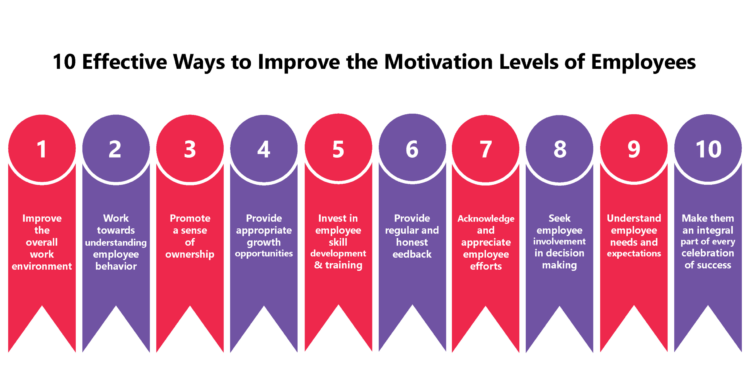
Every organization needs highly motivated and hardworking employees capable of taking it to new heights of success. Here are ten effective ways to improve the motivation levels of employees:
| Motivation Strategies | How to Implement | Business Impact |
|---|---|---|
| Improve the Overall Work Environment | Create a clean, well-lit, and aesthetically pleasing workspace; upgrade tools and technology; ensure comfort and functionality | Increases employee satisfaction, boosts morale, and enhances productivity by creating a positive work atmosphere |
| Understand Employee Behavior | Foster open communication, encourage authenticity, and build a collaborative environment where employees feel heard | Improves trust, reduces frustration, and enhances engagement and performance |
| Promote a Sense of Ownership | Involve employees in decision-making, align roles with business goals, and empower them with responsibility | Drives accountability, increases motivation, and improves overall productivity |
| Provide Growth Opportunities | Offer clear career paths, promotions, and role enhancements aligned with employee skills and aspirations | Enhances retention, increases motivation, and ensures long-term organizational growth |
| Invest in Skill Development & Training | Provide learning programs, certifications, and continuous development opportunities | Builds a future-ready workforce, improves performance, and enhances employee engagement |
| Provide Regular & Honest Feedback | Conduct frequent feedback sessions, performance reviews, and constructive discussions | Improves clarity, enhances performance, and fosters continuous improvement and alignment |
| Acknowledge & Appreciate Efforts | Recognize employee contributions through appreciation, rewards, and social recognition platforms | Boosts morale, increases engagement, and strengthens a culture of appreciation |
| Involve Employees in Decision-Making | Seek employee input in business decisions, projects, and process improvements | Enhances ownership, builds trust, and drives innovation and better decision-making |
| Understand Employee Needs & Expectations | Regularly assess employee expectations through surveys, feedback, and one-on-one discussions | Improves employee satisfaction, reduces disengagement, and aligns organizational initiatives with workforce needs |
| Celebrate Success & Milestones | Include employees in celebrations of team wins, milestones, and organizational achievements | Builds a sense of belonging, strengthens culture, and increases motivation and engagement |
A research conducted by Gallup showed that having a poorly motivated workforce costs US companies up to $550 billion annually.
Moreover, low motivation also results in 61% more employee burnout at the workplace, which directly impacts workforce efficiency and business productivity.

1. Improve the Overall Work Environment
2. Work towards Understanding Employee Behavior
3. Promote a Sense of Ownership
4. Provide Appropriate Growth Opportunities
5. Invest in Employee Skill Development and Training
6. Provide Regular and Honest Feedback
7. Acknowledge and Appreciate Employee Efforts
8. Seek Employee Involvement in Decision-making
9. Understand Employee Needs and Expectations
10. Make them part of every Celebration of Success

Employees feel happy and satisfied working in a functional, aesthetically pleasing, and fun environment.
To ensure employee happiness, organizations should keep the workspaces neat, clean, well-maintained, and well-lit.
They should replace outdated office equipment and integrate technology into everyday operations.
Investing in high-quality artwork and ergonomically designed furniture can improve the workspace.
It is common for employees to exhibit preferred behavior at work to please their superiors.
However, it can lead to frustration over time and hamper employees’ efficiency.
It is therefore important for organizations to promote an open and collaborative environment where employees can show their actual behavior.
Hence, it can significantly improve employees’ motivation.

Promoting a sense of ownership can prevent employees from developing a tunnel vision about their duties and timelines.
Hence, it motivates them to treat organizational goals as their own. It helps enhance employee productivity naturally.
Therefore, organizations must educate employees about their crucial role in driving organizational growth to ensure alignment with business objectives.
Also, all employees should be provided with appropriate growth opportunities for their specific skills and competency levels.
Hence, it assures employees that the organization truly cares for them, motivating them to give their best efforts to business growth.

Helping employees acquire new skills can improve their overall performance and efficiencies, as well as motivate them.
It assures employees that the organization is committed to their professional development. It also prepares them for greater responsibilities in the future.
Hence, they can use the new knowledge and skills from the training programs to contribute to the business.

Letting employees know how well they have performed is essential to keep them motivated to improve their performance.
Organizations publicly provide positive feedback while providing any negative feedback in person and discreetly.
Therefore, it is better to focus on the positive aspects of the employee’s work and discuss areas for development as opportunities for improvement.

Additionally, employee rewards and recognition are one of the most effective ways to keep the members of the workforce motivated.
Hence, appreciating their contributions and achievements can inspire them to repeat the good work until it becomes an everyday habit.
It can also motivate their peers, creating a genuinely appreciative and positive work culture.

Almost every decision made by an organization’s management impacts its employees, directly or indirectly.
Therefore, allowing employees to have a say in decision-making can go a long way in enhancing their motivation levels.
Hence, seeking their opinions and suggestions about specific decisions will make them more engaged and committed.

Even the most effective motivation strategies may fail if organizations fail to understand their employees’ needs and expectations.
Hence, understanding individual motivation factors can help organizations to keep them inspired and engaged effectively.
Most organizations find it surprising how trivial and seemingly unimportant things can have a profound impact on employees’ motivation.
Sharing success with employees is another effective way in which organizations can keep their employees motivated.
It helps build a deep sense of belonging among employees, even if they have not directly contributed to that project or work.
Implementing these strategies can help organizations improve the motivation levels of employees ensure that employees consider themselves to be valuable assets, and work towards driving business growth and profitability.

Lead author: Sagar Chaudhuri, the Co-Founder and CEO of HiFives. He is an HR Tech Evangelist with over 25 years of experience in both corporate and entrepreneurial settings. Previously, Sahas held leadership roles at companies including Genpact, Infosys, and ICICI Bank. He has an engineering degree from IIT Kharagpur and an MBA from IIM Lucknow. Connect on LinkedIn
To stay updated on the latest HiFives blogs, follow us on Twitter (@MyHiFives)
Ready to transform employee recognition at your company?
See how leading companies use HiFives to boost engagement, retention and productivity.
Book a Free DemoChat on WhatsApp