


Why organizations should digitize their employee recognition programs to make them more efficient and effective.
1. Enhances Employee Experience and Engagement: Digitization improves user experience, facilitates peer recognition, and makes recognition instant and timely, fostering higher engagement and motivation.
2. Reduces Administrative Effort and Costs: Automates manual processes, reducing administrative burdens and costs while enhancing transparency and fairness.
3. Increases Accessibility and Visibility: Provides access to remotely working employees and integrates with internal and social platforms for greater recognition and visibility.
Want a rewards program your employees actually love?
See how leading companies use HiFives to boost engagement, retention and productivity.
Book a Free DemoChat on WhatsApp4. Improves Alignment and Flexibility: Links recognition to performance metrics and goals and allows easy adjustments to align with changing business needs.
Employee recognition is a critical HR strategy for any organization today. Hence, it is unsurprising that an organization has already digitized its employee recognition program or is looking to digitize it to make it more efficient and effective.
The digitization of key business processes has become necessary for organizations to stay competitive and progressive in rapidly changing times.
| Key Reasons | Best Practices | Business Impact |
|---|---|---|
| Enable Real-Time Recognition | Integrate recognition into daily workflows and collaboration tools like Teams and Slack | Improves employee motivation, engagement, and behavioral reinforcement |
| Increase Employee Engagement | Encourage continuous peer-to-peer and manager-led recognition | Creates a stronger emotional connection and higher workforce participation |
| Improve Recognition Consistency | Standardize recognition processes across teams and locations | Reduces uneven employee experiences and strengthens workplace culture |
| Enhance Visibility of Appreciation | Use social recognition feeds, public appreciation walls, and digital shout-outs | Builds transparency, morale, and positive cultural momentum |
| Support Hybrid & Remote Workforces | Provide mobile-first and cloud-based accessibility | Ensures inclusive participation across distributed teams |
| Make Recognition Scalable | Automate workflows, milestones, approvals, and reward distribution | Supports organizational growth without increasing HR complexity |
| Strengthen Organizational Culture | Align recognition with company values and behaviors | Reinforces desired workplace behaviors and cultural alignment |
| Improve Manager Participation | Use AI nudges, reminders, and simplified recognition workflows | Encourages leaders to recognize employees more consistently |
| Enable Peer-to-Peer Recognition | Create open systems for employees to appreciate colleagues directly | Builds collaboration, trust, and stronger team relationships |
| Reduce Dependence on Manual Processes | Digitize nominations, approvals, rewards, and reporting | Improves efficiency and reduces administrative burden |
| Gain Data-Driven Insights | Use analytics dashboards to track participation and engagement trends | Enables better HR decision-making and ROI measurement |
| Increase Recognition Frequency | Promote micro-recognition and instant appreciation | Builds continuous engagement and everyday motivation |
| Improve Employee Retention | Recognize contributions consistently and meaningfully | Reduces disengagement and voluntary attrition |
| Enhance Employee Experience | Personalize recognition messages and rewards | Creates a stronger emotional connection and employee satisfaction |
| Reinforce Desired Behaviors | Recognize collaboration, innovation, ownership, and customer focus | Encourages repetition of high-impact behaviors |
| Improve Transparency & Fairness | Use centralized and trackable digital recognition systems | Reduces perceived bias and improves trust |
| Support Global & Distributed Teams | Enable multi-language support and global reward options | Improves inclusivity and consistency across geographies |
| Increase Recognition Accessibility | Offer mobile apps, browser access, and simple user interfaces | Drives higher adoption and participation rates |
| Encourage Social Recognition Culture | Enable likes, comments, badges, and public appreciation | Makes recognition more visible and contagious |
| Improve Employer Branding | Showcase recognition culture internally and externally | Strengthens reputation as an employer of choice |
| Strengthen Team Collaboration | Encourage cross-functional recognition and appreciation | Improves teamwork and organizational alignment |
| Reinforce Everyday Appreciation | Embed recognition into meetings, workflows, and communication channels | Creates a culture of gratitude and continuous motivation |
| Support Gen Z Workforce Expectations | Offer instant, digital, and social recognition experiences | Improves engagement among younger employees |
| Simplify Reward Management | Centralize reward catalogs, points, and redemption systems | Improves operational efficiency and employee satisfaction |
| Enable Recognition Analytics | Monitor recognition coverage, manager participation, and program effectiveness | Helps optimize recognition strategy and identify gaps |
| Improve Recognition Authenticity | Encourage personalized and behavior-specific appreciation | Makes recognition more meaningful and impactful |
| Drive Innovation & Participation | Recognize ideas, problem-solving, and initiative-taking | Encourages ownership and continuous improvement |
| Strengthen Leadership Visibility | Allow leaders to appreciate contributions publicly | Improves trust and leadership connection |
| Reduce Employee Invisibility | Ensure contributions are recognized across all levels | Improves belonging and workplace inclusion |
| Build a Continuous Recognition Culture | Move beyond annual awards to ongoing appreciation | Creates sustained engagement and a stronger workplace culture |
According to a recent industry report, 70% of organizations, including 38% of traditional businesses have already adopted a digital transformation strategy.
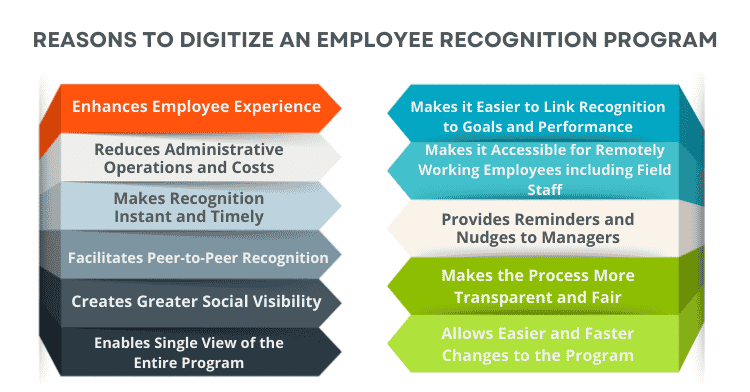
Let’s look at the key reasons for an organization to digitize its employee recognition program:
1. Enhances Employee Experience
2. Reduces Administrative Operations and Costs
3. Makes it Easier to Link Recognition to Goals and Performance
4. Makes Recognition Instant and Timely
5. Facilitates Peer-to-Peer Recognition
6. Creates Greater Social Visibility
7. Makes it Accessible for Remotely Working Employees, including Field Staff
8. Makes the Process More Transparent and Fair
9. Provides Reminders and Nudges to Managers
10. Enables a Single View of the Entire Program

With Gen Z and millennials making up most of the workforce, a technology-enabled employee recognition program will enhance the employee experience.
For a generation of employees who are completely comfortable with e-commerce, social media, and mobile apps, digitization of the employee recognition program is almost like a no-brainer.
Digitization can enhance the employee experience in many ways, leading to greater employee participation and engagement, as well as higher motivation, performance, and productivity.

A digital employee recognition platform can minimize the need for manual processes such as creating Excel spreadsheets, sending emails, and following up with multiple internal teams and external parties.
Digitization can enable the automation of processes based on predefined workflows.
The reduction in administrative operations involved in running an employee recognition program can help free up time and resources of the HR Team for other value-added activities.
Digitizing the program can also help minimize errors and delays, leading to additional cost savings.

The organization can easily integrate the digital employee recognition platform with other work platforms. By integrating with systems such as CRM, project management, and performance management, the recognition process closely aligns with employees’ performance.
The organization can integrate employee performance at work, measured in terms of Key Performance Indicators (KPIs) with the employee recognition platform, and can trigger recognition based on predefined criteria.
It can help the organization align the employee recognition program with the employees’ actual performance.
Also, read 5 Best Ways to Recognize Top Performers

Traditional employee recognition systems are not designed for instant recognition. Delays in acknowledging an employee’s achievements diminish the impact of that recognition.
Digitization of the recognition process makes it easier for managers and co-workers to offer instant and spot recognition as and when team members achieve something significant or exhibits desirable behaviors.
Timely recognition increases the effectiveness of the recognition process as compared to a traditional system.
Also, read Frequency of Employee Recognition Matters for Organizations

Peer-to-peer recognition has become one of the most significant drivers for enhancing employee engagement and motivation.
It can be challenging for organizations to implement peer-to-peer recognition through physical appreciation cards or appreciation boards.
A digital employee recognition platform can make the process of peer-to-peer recognition very simple.
Making this process easy for co-workers to appreciate each other encourages more employees to participate in the program and helps build a strong culture of appreciation within the organization.
Also, read Employee Recognition Program Can Drive Cultural Change

A digital employee recognition platform enables the program to gain greater visibility within the organization and, potentially, beyond.
The platform can integrate with internal collaboration tools such as Microsoft Teams, Slack, or Workplace. It can also integrate with external social media platforms such as LinkedIn, Facebook, and Twitter.
Employees can congratulate recipients on the employee recognition platform by liking their posts, thereby providing social recognition within the organization.
Greater visibility can be achieved through integration with internal and external platforms.

Recognizing employees who work remotely, such as field staff, is a big challenge for traditional employee recognition programs.
The massive shift towards remote working, fueled by the pandemic, multiplied this challenge.
Also, a digital employee recognition platform provides an easy way for remotely working employees to participate in the program.
So managers and co-workers can recognize team members, receive recognition, congratulate others, and even redeem rewards digitally.
Hence, it is one of the most compelling reasons for organizations to digitize the employee recognition program.

A digital employee recognition program makes the entire process transparent – the criteria, terminations, and winners.
Hence, employees have visibility into the entire process, making it more genuine and trustworthy in their minds.
Limits on the number and frequency set on the platform can prevent the same employees from being nominated multiple times and provide greater fairness in the overall recognition system.

Automated reminders and nudges to managers can enable timely and regular recognition of team members and help in building an overall culture of appreciation in the organization.
It is hard to replicate in a traditional recognition system without incurring excessive manual overhead.

A digital employee recognition program gives HR and management a bird’s-eye view at their fingertips.
They can track critical program metrics in real time and take the necessary actions.
Digital employee recognition platforms include dashboards, reports, and analytics that let the program managers understand the health of the program at any given point in time.
They can take timely actions based on these metrics and trends.
An employee recognition program needs to stand the test of time.
Hence, the program must be modified and enhanced over time to keep pace with changes in the organization’s business objectives and workforce expectations.
A digital employee recognition program makes it much easier and faster to implement changes such as adding new categories of recognition and changing the existing workflows or criteria for recognition.
However, in traditional recognition systems, making such changes can be pretty cumbersome and time-consuming.
Also read Employee Recognition: The Devil is in the Execution
There are many compelling business reasons for an organization to digitize its employee recognition program to make it more efficient and effective.
A digital employee recognition program can drive a much higher level of employee engagement and motivation as compared to a traditional offline system.

Lead author: Sagar Chaudhuri, the Co-Founder and CEO of HiFives. He is an HR Tech Evangelist with over 25 years of corporate and entrepreneurship experience. In the past, Sagar has held leadership roles at companies such as Genpact, Infosys, and ICICI Bank. He has an engineering degree from IIT Kharagpur and an MBA from IIM Lucknow. Connect on LinkedIn
To stay updated on the latest HiFives blogs, follow us on Twitter (@MyHiFives)
Ready to transform employee recognition at your company?
See how leading companies use HiFives to boost engagement, retention and productivity.
Book a Free DemoChat on WhatsApp