


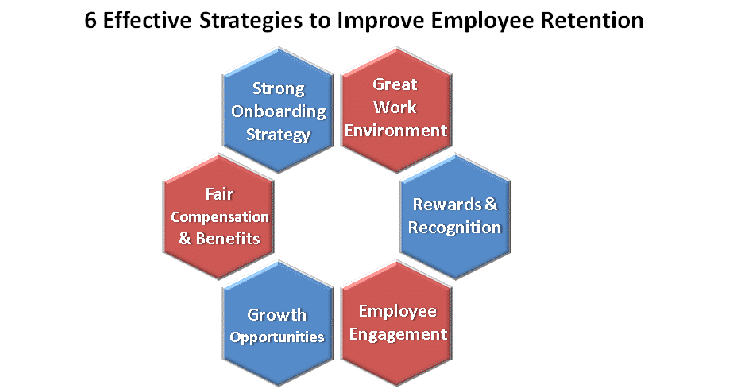
These 6 effective strategies to improve Employee Retention can help retain top talent, which in turn can enhance business growth.
1. Strong Onboarding: Implement a supportive onboarding strategy to build employee loyalty from day one.
2. Positive Work Environment: Create an open and relaxed environment to enhance employee satisfaction and performance.
3. Fair Compensation: Offer competitive, fair pay and benefits based on skills, expertise, and industry standards.
4. Growth Opportunities: Offer clear career paths, training, and development opportunities that align with employee aspirations.
5. Improve Engagement: Foster high employee engagement to boost commitment and retention.
6. Timely Recognition: Recognize employee efforts and achievements to strengthen loyalty and motivation.
Most organizations find it challenging to hire top talent, but ensuring long-term retention is even more difficult. Employee retention is a primary concern for most organizations, driven by a competitive job market that offers professionals numerous employment options. Here are six effective strategies to improve employee retention.
| Key Strategies | Best Practices | Potential Impact |
|---|---|---|
| Strong Employee Onboarding | Create structured onboarding programs that align employees with organizational culture, goals, and expectations from day one | Improves employee confidence, engagement, and early-stage retention |
| Positive Work Environment | Foster an open, collaborative, respectful, and psychologically safe workplace culture | Enhances employee satisfaction, productivity, and loyalty |
| Fair Compensation & Benefits | Benchmark salaries regularly and provide competitive pay, wellness benefits, and flexible policies | Reduces attrition risk and improves employee motivation |
| Career Growth Opportunities | Offer clear career paths, mentoring, internal mobility, and skill development initiatives | Strengthens employee commitment and long-term retention |
| Continuous Employee Recognition | Implement real-time, peer-to-peer, and manager-led recognition programs | Improves morale, engagement, and emotional connection with the organization |
| Employee Engagement Initiatives | Conduct pulse surveys, engagement campaigns, and feedback-driven interventions regularly | Increases employee participation and organizational commitment |
| Flexible Work Arrangements | Provide hybrid work, flexible schedules, and outcome-driven work policies | Improves work-life balance and employee satisfaction |
| Employee Wellness & Mental Health Support | Introduce wellness programs, counseling support, and burnout prevention initiatives | Reduces stress, absenteeism, and turnover rates |
| Timely & Instant Recognition | Enable spot awards and immediate appreciation through digital platforms | Reinforces positive behaviors and improves employee motivation |
| Peer-to-Peer Recognition Culture | Encourage employees to appreciate and celebrate colleagues openly | Builds camaraderie, teamwork, and stronger workplace relationships |
| Leadership Visibility & Communication | Ensure leaders communicate transparently and actively appreciate employees | Builds trust and strengthens organizational alignment |
| Recognition Linked to Organizational Values | Reward employees for behaviors aligned with company culture and goals | Reinforces desired workplace culture and accountability |
| Learning & Upskilling Opportunities | Invest in certifications, continuous learning, and professional development programs | Improves workforce capability and employee retention |
| Employee Feedback & Listening Mechanisms | Use pulse surveys, one-on-one discussions, stay interviews, and eNPS tracking | Helps organizations identify engagement gaps proactively |
| Recognition of Personal Milestones | Celebrate birthdays, anniversaries, promotions, and life milestones | Enhances emotional connection and employee belongingness |
| Inclusive & Collaborative Workplace Culture | Promote diversity, teamwork, and cross-functional collaboration | Improves innovation, morale, and workforce inclusiveness |
| Manager Enablement & Coaching | Train managers to provide regular feedback, coaching, and appreciation | Improves manager effectiveness and team engagement |
| Technology-enabled Employee Experience | Use digital HR and recognition platforms integrated with Teams, Slack, HRMS, and mobile apps | Improves scalability, accessibility, and employee participation |
| Recognition for Innovation & Ownership | Reward initiative-taking, problem-solving, and innovation-driven contributions | Encourages accountability, creativity, and organizational agility |
| Continuous Culture-building Efforts | Position retention and engagement as long-term strategic priorities rather than short-term HR activities | Strengthens employer branding, retention, productivity, and sustainable growth |

Organizations understand the importance of retaining their employees for the long term.
Ensuring the retention of their employees for a long time helps in reducing the HR costs of an organization quite significantly.

Higher retention impacts critical aspects of the business and workforce:
1. Cost savings in hiring and training
2. Productivity and efficiency
3. Stability of business operations
4. Continuity of customer relationships
5. Retention of knowledge
6. Sustenance of employee engagement levels
7. Preservation of work culture
These benefits are compelling enough to justify the efforts of an organization required to improve employee retention rates.

The growing demand for top talent necessitates that organizations focus on employee retention.
Given below are the six best strategies to improve employee retention that organizations may follow in this context to get the desired benefits:
1. Have a strong onboarding strategy
2. Create a great work environment
3. Adopt a policy of fair compensation and benefits
4. Provide appropriate growth opportunities
5. Work towards improving employee engagement
6. Ensure proper recognition of employees

The strategy to ensure long-term employee retention should take effect from the day they join the organization.
Hence, organizations must have an onboarding strategy that assures recruits of support and guidance from day one.
It is essential to set the right tone for new employees and induce loyalty towards the organization from day one.
New employees need to understand the organization’s vision, mission, and goals, and feel aligned with them.

Employees today prefer to work in organizations that offer an open, relaxed, and positive work environment.
Even the most competent employees will seek job opportunities elsewhere if the work environment is stressful and disturbing.
Hence, organizations should create a work environment that fosters a positive atmosphere and enhances employee performance and efficiency.

Organizations should offer fair compensation and benefits to all employees based on their specific skills, expertise, and job roles.
Hence, organizations back this up with a robust goal-setting, performance management, and compensation management system.
Employee motivation levels are significantly impacted by the compensation package and perks being offered to them by the organization.
Hence, employees may seek other opportunities if their salary and benefits do not align with their roles, responsibilities, experience, and expertise.
Organizations must ensure that compensation and benefits are competitive with industry benchmarks and that these benchmarks are reviewed periodically.

Every employee in an organization seeks growth opportunities that align with their career aspirations and objectives.
The lack of such opportunities can often make employees doubt their self-worth and significantly reduce their confidence.
It can hurt their work efficiency, and they might seek options beyond the organization.
Hence, employees should be provided with clear career paths, challenging assignments, and appropriate training to help them build skills and progress in their careers.
Therefore, organizations can hope to earn their employees’ trust and loyalty by providing them with appropriate growth opportunities.

Employees engaged in organizational activities and initiatives are less likely to leave the organization quickly.
So, implementing policies that motivate employees to be integral to the organization, is the key to their commitment and dedication.
It is well known that higher employee engagement is associated with greater commitment and dedication to the organization.
Hence, this positively impacts their decision to stay with the organization.

Additionally, promptly and adequately recognizing employees for their efforts, contributions, and achievements is crucial to improving retention.
Such initiatives go a long way toward enhancing employee loyalty and fostering a stronger emotional connection with the organization.
Hence, recognition helps to keep employees motivated and assures them that their efforts are valued by the organization.
So it inspires them to keep giving their best.

Retaining employees reduces hiring and training costs, maintains productivity, preserves institutional knowledge, stabilizes operations, and helps sustain business culture and customer relationships.
Implement a strong onboarding strategy—make new hires feel supported from day one by introducing them to the company’s vision, mission, and goals.
A relaxed, open, positive workplace reduces stress and increases satisfaction. If the environment is toxic, even skilled employees will look elsewhere.
Yes—fair pay and benefits aligned with industry standards, skills, and experience are crucial. Employees often leave when they feel undercompensated.
When employees see a clear career path and have access to training and challenging roles, they feel valued and are more likely to stay.
Engaged employees—those involved in the organization, aligned with its goals, and motivated—are less likely to leave. Engagement fosters commitment.
Immensely—it strengthens loyalty and motivation. Timely recognition makes employees feel their work is valued, which encourages them to continue performing well.
Absolutely. Retention improves best when firms apply multiple strategies (strong onboarding, engagement, recognition, etc.) rather than relying on just one.
Risks include higher turnover, loss of talent and knowledge, increased hiring and training costs, lower morale among the remaining staff, and negative impacts on customer service and business continuity.
Start by reviewing your onboarding process—ensure new hires are welcomed, appropriately oriented, understand goals, and feel supported from their first day. It is a good foundation.
Organizations should implement these 6 effective strategies to improve employee retention significantly. This can positively impact the long-term growth, productivity, and success of the organization.

Lead author: Sagar Chaudhuri, the Co-Founder and CEO of HiFives. He is an HR Tech Evangelist with over 25 years of experience in both corporate and entrepreneurial settings. Previously, Sagar has held leadership roles at companies such as Genpact, Infosys, and ICICI Bank. He has an engineering degree from IIT Kharagpur and an MBA from IIM Lucknow. Connect on LinkedIn
To stay updated on the latest HiFives blogs, follow us on Twitter (@MyHiFives)
Employee Rewards, Recognition and Engagement Platform