


Employee recognition during difficult times, when done effectively, can elicit support, dedication, and commitment from employees.
1. Continuing employee recognition during difficult times boosts employee morale, commitment, and a sense of safety.
2. Recognizing employees’ efforts under challenging conditions enhances their loyalty and strengthens customer relationships.
3. Effective recognition methods during crises include utilizing digital platforms for instant recognition, offering electronic gift cards, and public acknowledgment on broader social media forums.
4. Maintaining recognition programs during tough times ensures employees feel valued and motivated, leading to long-term organizational benefits.
Many organizations scale back or temporarily suspend employee recognition during challenging times due to financial constraints and other pressures. On the contrary, a good employee recognition program, especially during a crisis, might have a more significant impact than during good times.
| Key Strategies | Best Practices | Business Impact |
|---|---|---|
| Increase Recognition Frequency | Encourage managers and peers to recognize employees more frequently during periods of uncertainty or disruption | Boosts morale, motivation, and emotional resilience |
| Real-time Recognition | Deliver appreciation immediately after achievements or positive behaviors instead of delaying recognition | Reinforces positive behaviors quickly and improves employee engagement |
| Leadership-led Appreciation | Ensure leaders visibly acknowledge employee contributions and communicate gratitude regularly | Builds trust, confidence, and stronger organizational connection |
| Empathy-driven Recognition | Recognize not only outcomes but also effort, adaptability, resilience, and collaboration | Improves psychological safety and employee well-being |
| Digital Recognition Platforms | Use digital platforms integrated with Teams, Slack, HRMS, and mobile apps for seamless recognition | Enables scalable and continuous appreciation across distributed teams |
| Recognition in Remote & Hybrid Work | Ensure remote employees receive equal visibility and recognition opportunities | Reduces isolation and improves engagement in distributed work environments |
| Peer-to-Peer Recognition Culture | Encourage employees to appreciate colleagues openly and frequently | Strengthens teamwork, collaboration, and workplace positivity |
| Recognition for Adaptability & Innovation | Reward employees who demonstrate agility, creativity, and problem-solving during challenging situations | Encourages innovation and organizational resilience |
| Transparent Communication | Combine recognition initiatives with clear and honest communication from leadership | Improves employee trust and reduces uncertainty-driven stress |
| Celebrate Small Wins | Acknowledge incremental achievements and daily efforts, not just major milestones | Maintains momentum and keeps employees motivated during difficult periods |
| Well-being-focused Recognition | Integrate wellness support, mental health awareness, and appreciation initiatives | Improves employee wellness and reduces burnout risk |
| Personalized Recognition Experiences | Tailor appreciation messages, rewards, and gestures to individual employee preferences | Increases emotional impact and employee satisfaction |
| Recognition for Frontline & Essential Workers | Ensure frontline and operational employees are consistently appreciated and included | Enhances inclusiveness and improves workforce morale |
| Social Recognition Visibility | Use public recognition feeds, badges, and appreciation walls to celebrate contributions visibly | Creates a culture of positivity and inspires others across teams |
| Recognition Linked to Organizational Values | Align recognition with values such as resilience, teamwork, customer focus, and accountability | Reinforces desired culture and strengthens organizational identity |
| Manager Training for Recognition | Train managers to deliver meaningful, authentic, and timely appreciation | Improves manager effectiveness and employee-manager relationships |
| Frequent Employee Listening | Use pulse surveys and feedback mechanisms to understand employee sentiment continuously | Enables proactive interventions and improves engagement strategies |
| Inclusive Recognition Programs | Ensure equal participation opportunities across departments, locations, and employee levels | Improves belongingness and strengthens workplace culture |
| Recognition with Flexible Rewards | Offer flexible reward choices such as digital gift cards, experiences, wellness benefits, or points | Improves reward relevance and employee participation |
| Continuous Reinforcement of Positivity | Use recognition campaigns and appreciation initiatives consistently throughout difficult periods | Sustains employee engagement and improves organizational stability |
| Recognition for Collaboration | Appreciate employees supporting colleagues, cross-functional teams, and organizational continuity | Encourages teamwork and strengthens collaboration |
| Mobile-first Recognition Access | Enable recognition through mobile devices and lightweight digital interfaces | Improves participation among remote and frontline employees |
| Recognition Analytics & Insights | Track recognition trends, participation levels, and engagement patterns regularly | Helps optimize programs and improve ROI visibility |
| Building Emotional Connection | Use recognition to make employees feel valued, supported, and connected to the organization | Strengthens loyalty, retention, and organizational commitment |
| Long-term Culture Reinforcement | Position recognition as a core cultural strategy rather than a temporary crisis response | Creates sustainable engagement and long-term workforce resilience |

The COVID-19 health crisis in 2020 that had engulfed the entire world had given us an opportunity to understand the significance of rewards and recognition during troubled times.
During the pandemic, employees ensured that their organizations could fulfill their commitments to customers.

Most of these employees did so at significant risk to their health and well-being, making it even more crucial for their employers to appreciate their efforts.
Recognizing employees during critical times is essential to keep up their morale and motivate them to keep doing their best.
Even employees who worked from home grappled with challenges ranging from poor network connectivity to an erratic power supply to home-related issues.
Despite these challenges, they strive to deliver projects on time and meet client commitments. Organizations should also recognize their efforts.
While it might seem counterintuitive, continuing a good employee recognition program can significantly benefit organizations, even during tough times.
Organizations need to recognize the efforts of their employees who are working against all odds to keep their businesses running.
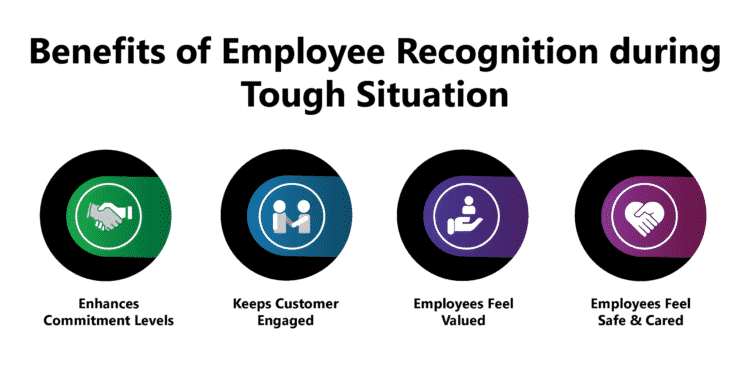
Here are a few benefits of doing so:
1. Enhances their commitment levels
2. Keeps customers engaged
3. Makes them feel valued
4. Makes them feel safe and cared for

When organizations choose to recognize and appreciate their employees even during tough times, it strengthens their sense of belonging and loyalty toward the organization.
This dedication and commitment enable them to complete their tasks, meet deadlines, and achieve targets, even in the most challenging situations.

One of the biggest benefits of recognizing employees during difficult times is that they pass on the same sense of comfort and care to their customers which helps in building great long-term relationships.
These customers will likely stay with the organization longer and provide more business opportunities once the situation normalizes.

Appreciating the efforts of employees in highly stressful times assures them of the support of their employers.
It strengthens their belief that their contribution is noticed by the people who matter most. It can improve their long-term motivation well beyond the current crisis.

It also helps establish a humanitarian connection between employees and the organization.
The employees feel valued and respected by their employers, ensuring their long-term commitment to the organization.
During difficult times, it is important for organizations to have an appropriate recognition strategy for all types of employees.
These include employees working from home, in the office, or in the field.
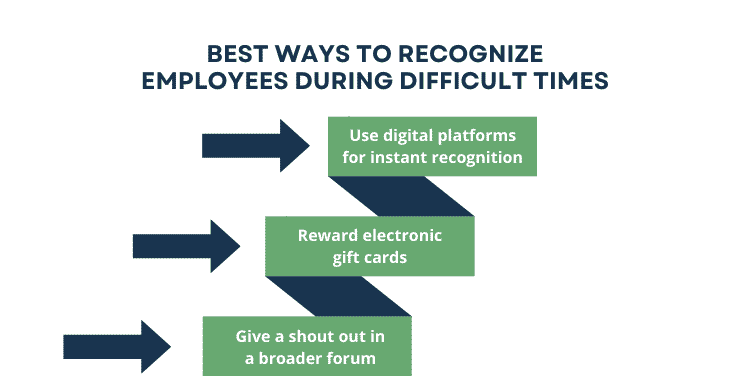
Here are a few practical ways in which organizations can recognize their employees during tough times:
1. Use digital platforms for instant recognition
2. Reward electronic gift cards
3. Give a shout-out in a broader forum

Organizations can also utilize digital employee recognition software platforms, such as HiFives, to instantly recognize their employees.
The platform can enable managers and co-workers to send appreciation/ ‘thank you’ emails to their co-workers.
If you cannot thank someone in person, a digital ‘Thank You’ might work as well.

Electronic gift cards are an effective way to recognize employees, and using them during difficult times is a sensible approach.
Employee recognition software platforms, such as HiFives, offer employees hundreds of gift cards that can be delivered via email.
Employees can use these gift cards to buy groceries, other essentials, fashion and lifestyle products, dining and food delivery, travel and entertainment, etc.
Platforms like HiFives enable employees to choose gift card brands that best match their needs and preferences.

Acknowledging and appreciating employees on organization-wide platforms can go a long way in boosting their morale and keeping them motivated.
Digital platforms such as HiFives ensure that recognition of employee achievements can be visible across the organization through digital walls/ boards.
It also enables co-workers to congratulate the winners digitally on the wall. Organizations can utilize their official social media channels to recognize employee achievements.
Employee recognition during difficult times, when done in a timely and effective manner can garner the required support, dedication, and commitment of their employees.

Lead author: Sagar Chaudhuri, the Co-Founder and CEO of HiFives. He is an HR Tech Evangelist with over 25 years of experience in both corporate and entrepreneurial settings. Previously, Sagar has held leadership roles with companies such as Genpact, Infosys, and ICICI Bank. He has an engineering degree from IIT Kharagpur and an MBA from IIM Lucknow. Connect on LinkedIn
To stay updated on the latest HiFives blogs, follow us on Twitter (@MyHiFives)