

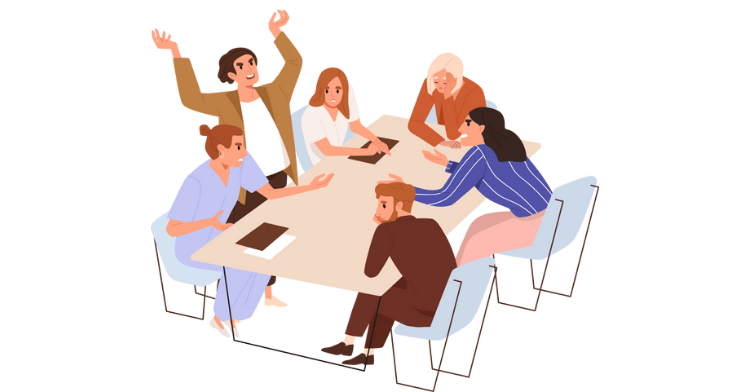
1. Boosts Employee Well-being and Productivity: Fun activities at work reduce stress and enhance employee well-being and productivity, leading to improved performance, reduced sick days, and cost savings for the organization.
2. Increases Commitment and Retention: A fun work environment fosters a sense of loyalty and attachment among employees, improving retention rates and reducing hiring costs.
3. Improves Teamwork and Communication: A relaxed and enjoyable workplace encourages open communication, mutual trust, and teamwork, enhancing overall organizational productivity and collaboration.
4. Encourages Creativity and Innovation: Fun at work stimulates creative thinking and innovation, enabling employees to develop innovative solutions and contributing to improved business outcomes.
The common perception of the workplace is that it is a grave, dull, and gloomy space dedicated to performing various professional tasks in a no-nonsense environment. Organizations are gradually changing their approach by introducing fun activities at work to enhance employee motivation and engagement.
| Best Practices | Implementation Strategy | Business Impact |
|---|---|---|
| Organize Team-building Activities | Conduct sports competitions, adventure outings, group games, and collaborative activities regularly | Improves teamwork, communication, and employee engagement |
| Create a Fun & Positive Work Environment | Encourage informal interactions, celebrations, humor, and enjoyable workplace experiences | Enhances employee happiness, morale, and workplace satisfaction |
| Use Gamification in Engagement Programs | Introduce badges, points, leaderboards, contests, and achievement milestones | Increases engagement, productivity, and employee participation |
| Celebrate Employee Achievements Creatively | Use fun award titles, quirky recognition categories, and entertaining award ceremonies | Makes recognition memorable and improves employee motivation |
| Encourage Peer-to-Peer Interaction | Promote informal collaboration and social engagement activities across teams | Strengthens workplace relationships and collaboration |
| Plan Informal Social Activities | Organize happy hours, lunch outings, movie sessions, and creative workshops | Reduces stress and improves employee bonding |
| Conduct Friendly Intra-office Competitions | Host karaoke, sports tournaments, quizzes, and innovation contests | Builds camaraderie and healthy competition |
| Support Volunteering & Social Causes | Arrange social responsibility and volunteering initiatives involving employees | Strengthens team bonding and improves employer brand perception |
| Recognize Unique Employee Traits | Introduce fun awards recognizing creativity, humor, problem-solving, or personality traits | Creates a more engaging and emotionally connected workplace culture |
| Promote Leadership Participation in Fun Activities | Encourage leaders to participate in informal and engagement initiatives actively | Builds trust and strengthens leadership visibility |
| Encourage Cross-functional Interaction | Design activities involving employees from different teams and departments | Breaks silos and improves organizational collaboration |
| Use Digital Platforms for Engagement | Leverage digital recognition and engagement tools for contests, celebrations, and social recognition | Improves scalability and participation across distributed teams |
| Support Hybrid & Remote Employee Engagement | Organize virtual games, online celebrations, and digital social events for remote employees | Reduces isolation and improves connection in hybrid workplaces |
| Encourage Creativity & Innovation | Use brainstorming games, innovation challenges, and creative collaboration activities | Drives innovation and problem-solving capabilities |
| Create Informal Recognition Moments | Recognize employees casually during meetings, social events, and daily interactions | Sustains motivation and reinforces positive culture |
| Ensure Activities are Inclusive | Design activities suitable for different personality types, generations, and employee groups | Improves inclusiveness and employee participation |
| Rotate Engagement Formats Frequently | Introduce new themes, contests, games, and event formats regularly | Prevents engagement fatigue and maintains excitement |
| Measure Engagement & Participation Levels | Use surveys, analytics, and participation tracking to optimize initiatives | Enables data-driven improvement of engagement programs |
| Focus on Employee Well-being Through Fun Activities | Use wellness games, relaxation activities, and stress-relief initiatives | Reduces burnout and improves employee well-being |
| Build a Long-term Fun-at-work Culture | Treat fun activities as an ongoing engagement strategy rather than occasional events | Improves retention, productivity, employer branding, and organizational culture |

Over the past several years, organizations have increasingly focused on enhancing employees’ happiness and satisfaction.
Hence, this change has been driven by the awareness that happy employees tend to be more productive and engaged.
That is why organizations invest time and effort to make the workplace more enjoyable.

Hence, towards this goal, they are introducing and implementing a wide range of fun at-work activities and strategies.
Such initiatives can offer tangible positive benefits for employees, teams, and the organization.
It is because when employees work in an environment where they consistently feel happy and satisfied, their productivity and performance naturally improve.

Several studies conducted over the past two decades have shown that organizations that make fun of work activities an integral part of their work culture enjoy a higher level of employee engagement.
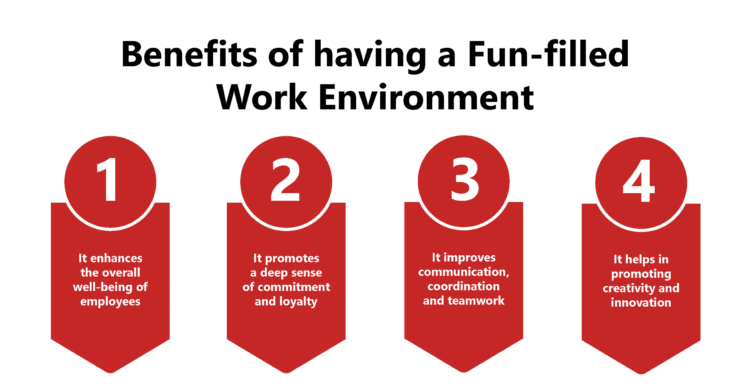
In addition, a fun-filled environment at work proves beneficial for business organizations in the following ways:
1. Enhances the overall well-being of employees
2. Promotes a deep sense of commitment and loyalty
3. Improves communication, coordination, and teamwork
4. Helps in promoting creativity and innovation

As mentioned earlier, when employees enjoy being at work, their work-related stress is significantly reduced.
Hence, their happiness quotient increases and improves their health and well-being positively.
Since healthier employees are less likely to take days off, this improves their overall performance and efficiency.
More importantly, it helps organizations save significantly through unused sick leave and medical benefits.

The primary goal of creating a fun work environment is to boost employees’ happiness and satisfaction.
Such employees feel a deep sense of attachment to the organization.
It minimizes their chances of seeking other job opportunities that may promise greater compensation.
Hence, it helps organizations maintain a decent employee retention rate and improves their employer brand value among prospective candidates.
A higher retention rate also reduces hiring costs, further increasing profits.

A relaxed environment enables employees to interact with co-workers and superiors openly and respectfully.
Hence, it promotes a sense of mutual trust, understanding, and respect among the members of the workforce.
They can express their ideas and opinions without fearing rejection or embarrassment.
Additionally, when employees enjoy working together, they are more likely to collaborate and complete tasks.
So this helps improve the organization’s productivity and ensures more significant business benefits.

A fun environment encourages employees to think outside the box and develop creative and innovative solutions to business problems.
Fun activities, especially those that involve challenges and problem-solving, stimulate the imagination of employees and enhance their creative skills.
The energy, excitement, and participation of colleagues further encourage skill development.
Employees can then use these skills to achieve better results and ensure a higher ROI for their organization.
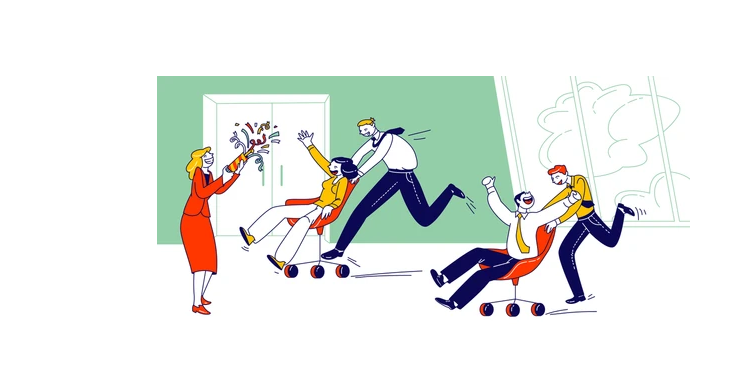
Creating a fun-filled work environment to improve employee productivity is not such a difficult task.
The following tips can help you accomplish this quickly and easily:
1. Foster a relaxed work environment by promoting casual interactions between colleagues beyond lunch hours or tea breaks.
2. Regularly organize friendly competitions between work teams and give unusual prizes to the winners.
3. Set a specific time every week when employees stop working and discuss anything and everything under the sun.
4. Organize high teas, lunches, and picnics to break barriers and facilitate employee socializing.
5. Hence, a fun environment where employees love to work and play can drive business success.
Organizations often deliberate on whether fun at work makes sense from the perspective of the overall HR strategy
The experience of most organizations has shown that having a fun-filled work environment where employees love to work and play can go a long way in driving business success.

Lead author: Sagar Chaudhuri, the Co-Founder and CEO of HiFives. He is an HR Tech Evangelist with over 25 years of experience in both corporate and entrepreneurial settings. Previously, Sagar has held leadership roles at companies including Genpact, Infosys, and ICICI Bank. He has an engineering degree from IIT Kharagpur and an MBA from IIM Lucknow. Connect on LinkedIn
To stay updated on the latest HiFives blogs, follow us on Twitter (@MyHiFives)