


Organizations need to develop effective strategies to improve employee engagement, as it helps them gain an edge over the competition.
1. Ensure a Great Onboarding Experience: Create a positive first impression for new employees to foster a sense of belonging and loyalty from day one.
2. Provide Career Development Opportunities: Enhance employees’ engagement and motivation by offering growth paths and professional development aligned with their skills and goals.
3. Empower Employees: Encourage employees to discover their potential by assigning challenging tasks, supporting them in decision-making, and avoiding micromanagement.
4. Promote Open Communication: Foster a culture of honest, transparent communication, allowing employees to share their views and opinions, which builds trust and strengthens engagement.
5. Reward and Recognize: Appreciate employees’ efforts, achievements, and contributions.
Today, employee engagement has emerged as a critical strategy for organizations to gain a competitive edge. Therefore, organizations need to find effective ways to improve employee engagement.

Employee engagement goes beyond organizing occasional get-togethers or rewarding employees for their excellent work.
Employee Engagement is more about implementing strategies that enhance an employee’s sense of belonging to the organization.
It is also about helping employees believe in the organization’s future and contribute their full potential.
Having the right engagement strategies in place is essential for organizations looking to develop a highly productive and efficient workforce.
While every workforce’s engagement needs may vary, some common strategies work well in most environments.

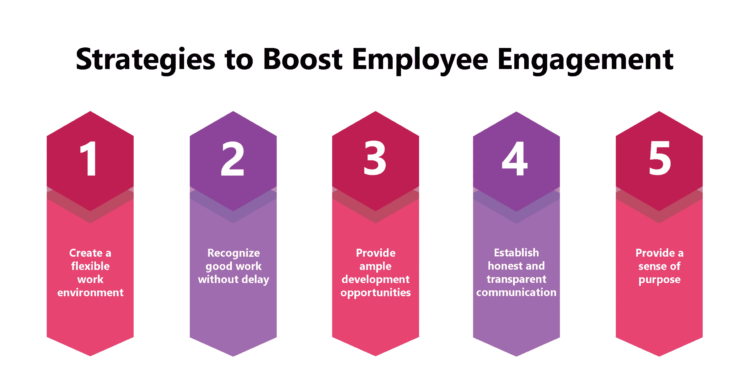
A few practical strategies that can go a long way in improving employee motivation levels are as follows:
1. Ensure a great onboarding experience
2. Provide relevant career development opportunities
3. Empower employees to discover their potential
4. Appreciate their individual and combined achievements
5. Promote open, honest, and transparent communication

Making a good first impression is the key to ensuring high employee engagement levels from day one.
A great onboarding experience assures the employees that the organization truly cares about the members of its workforce.
It also helps establish the right mindset and makes them feel involved with the organization.
Such employees are more likely to develop a deep sense of belonging and loyalty and stay with the organization for a long time.

Organizations need to understand that individual employees have specific professional skills and career development objectives.
Offering appropriate career development opportunities to employees can boost their sense of engagement.
Employees feel truly valued when organizations provide career paths that match their skills and experience.
It significantly motivates them to improve their contributions to the business’s growth.

Discovering their true potential is the key to providing employees with the right career growth opportunities.
For this, organizations need to empower employees and enable them to discover what they are capable of.
For example, assign projects and tasks slightly beyond employees’ usual capabilities and comfort levels. It helps build employees’ confidence, self-worth, and trust.
Empowering employees also requires managers and supervisors to step back, stop micromanaging, and let them make decisions while supporting them as needed.
It might also mean tolerating small failures and preparing for bigger challenges.

Recognizing employees’ efforts and achievements is essential to boosting engagement.
In addition to appreciating individual employees, organizations also need to have policies for recognizing team efforts and achievements.
However, recognition and appreciation are effective only when offered on time and consistently.
Organizations must remember that the most expensive rewards and cash incentives cannot always guarantee results.
Instead, the intent behind employee recognition and how it is delivered matters the most.

Honest and transparent communication in the workplace is another effective strategy to improve employee engagement.
It is not only about sharing important information with employees but also listening to their views and opinions.
Implementing this strategy strengthens mutual trust between employees and management.
This two-way communication is one of the most critical aspects of building strong employee engagement in the organization.
Creating a workplace where the employees are highly engaged and motivated can ensure greater benefits for both the business and the individual members of the workforce.
The strategies above can go a long way toward creating a significant competitive advantage for the business.

Lead author: Sagar Chaudhuri, the Co-Founder and CEO of HiFives. He is an HR Tech Evangelist with over 25 years of corporate and entrepreneurial experience. Sagar has held leadership roles at companies such as Genpact, Infosys, and ICICI Bank. He has an engineering degree from IIT Kharagpur and an MBA from IIM Lucknow. Connect on LinkedIn
To stay updated on the latest HiFives blogs, follow us on Twitter (@MyHiFives)