


A culture of collaboration through employee recognition is an effective way for organizations to enhance team bonding and team effectiveness.
1. Building a culture of collaboration through employee recognition enhances teamwork and organizational efficiency.
2. Best practices include educating employees on the importance of collaboration, fostering trust, and promoting social bonds.
3. Recognizing employees boosts their happiness, sense of ownership, and support for coworkers, thereby reinforcing collaborative behavior.
Want a rewards program your employees actually love?
See how leading companies use HiFives to boost engagement, retention and productivity.
Book a Free DemoChat on WhatsApp4. Peer-to-peer recognition and public acknowledgment foster transparency, trust, and a strong sense of community within the organization.
Effective collaboration has become recognized as one of the most critical contributors to business success. Hence, fostering a culture of collaboration through employee recognition is one of the most effective ways to enhance teamwork and improve the organization’s overall efficiency.
| Key Strategies | Best Practices | Business Impact |
|---|---|---|
| Align Recognition with Team & Organizational Goals | Design recognition programs that reward collaborative outcomes, shared goals, and cross-functional success rather than just individual performance | Encourages teamwork, reduces silos, and improves collective accountability and performance |
| Promote Peer-to-Peer Recognition at Scale | Enable employees to appreciate colleagues through social feeds, shout-outs, and nominations; make recognition visible across teams | Builds trust, strengthens relationships, and fosters a strong sense of camaraderie and collaboration |
| Recognize Team Achievements, Not Just Individuals | Introduce team-based awards, group incentives, and shared recognition moments in meetings or platforms | Reinforces collective success, encourages knowledge sharing, and drives stronger team alignment |
| Make Recognition Frequent and Timely | Encourage real-time recognition for collaborative behaviors such as helping peers, problem-solving, and cross-team support | Sustains collaboration momentum and reinforces positive behaviors when they matter most |
| Embed Recognition into Daily Workflows | Integrate recognition into collaboration tools, meetings, and project workflows to ensure it becomes a habit | Increases participation, improves adoption, and embeds collaboration into everyday work culture |
| Encourage Cross-Functional Collaboration Recognition | Reward employees who contribute beyond their teams or collaborate across departments | Breaks down organizational silos and enhances innovation through diverse perspectives |
| Personalize and Diversify Recognition Methods | Offer a mix of public appreciation, private acknowledgment, and rewards tailored to employee preferences | Increases inclusivity and ensures recognition resonates across diverse teams |
| Ensure Transparency and Inclusivity in Recognition | Create clear criteria for recognition; ensure equal opportunity for all employees to be recognized | Builds fairness, trust, and psychological safety, which are critical for open collaboration |
| Leverage Technology to Scale Collaborative Recognition | Use digital platforms to enable real-time, social, and organization-wide recognition across locations | Enhances visibility, connects distributed teams, and scales collaboration effectively |
| Measure, Reinforce, and Evolve Collaboration Behaviors | Track participation, collaboration metrics, and engagement; refine programs based on insights | Improves ROI of R&R programs and continuously strengthens a collaboration-driven culture |
At its core, building a collaborative culture is about bringing people together and promoting teamwork.

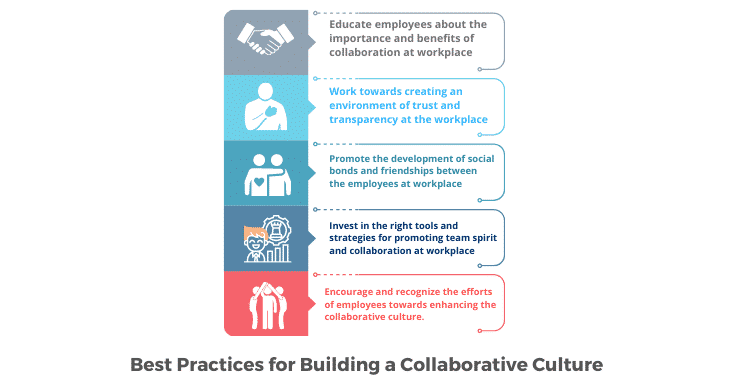
Here are a few best practices:
1. Educate employees about the importance and benefits of collaboration at the workplace.
2. Work towards creating an environment of trust and transparency.
3. Foster the development of social bonds and friendships among employees at the workplace.
4. Invest in the right tools and strategies to promote team spirit and collaboration in the workplace.
5. Encourage and recognize employees’ efforts towards enhancing the collaborative culture.
Overall, recognizing employees for helping and supporting their coworkers helps the organization encourage and reinforce collaborative behavior.
So, here is how employee recognition impacts collaboration in the workplace:
1. Recognized Employees are happier, likely to be more supportive of their co-workers
2. Recognized Employees are likely to have a greater sense of ownership and are more likely to help coworkers
3. Team Awards and Recognition motivate employees to work together to get the best results
4. Peer-to-Peer Recognition builds transparency and trust
5. Social acknowledgment of recognition within the organization promotes camaraderie and team spirit

Recognizing employees helps in enhancing their sense of self-worth, confidence, and overall level of satisfaction.
When employees feel satisfied with their work and the contribution it makes to business growth, they are more likely to develop a more supportive attitude towards their colleagues.
Thus, employee recognition significantly enhances team spirit among members of the workforce.

Additionally, recognition assures employees that their organization values their efforts and acknowledges their contributions.
Therefore, he fills them with a sense of pride, belonging, and ownership of the organization.
Such employees are likely to be more motivated to help their colleagues when and as needed.
Hence, they understand that such help and support can contribute to the business growth.

Additionally, recognizing functional and project teams, as well as teams working on cross-functional initiatives, for their performance motivates employees to work together more effectively.
Hence, such team recognition promotes social bonding between employees and makes it easier for them to work together, learn from, and support each other.

Also, a well-designed and implemented peer-to-peer recognition program can help create a culture of mutual appreciation and enhance the level of trust and collaboration within the workforce.
Also, as employees acknowledge and appreciate each other’s achievements and support one another, the process becomes reciprocal and ingrained in the workplace culture.
Therefore, this creates openness, transparency, and improved communication within the workforce.

Additionally, digital employee recognition platforms can help organizations increase social visibility of their employee rewards and recognition programs.
When coworkers acknowledge and congratulate the recognized employees, it creates a virtuous circle of appreciation within the organization.
Therefore, this helps establish a strong sense of community and belonging among the workforce.
Hence, such positive sentiments can significantly enhance team spirit and collaboration.
Overall, creating a culture of collaboration through employee recognition is an effective way for organizations to enhance team bonding and the effectiveness of teams working among their workforce.

Lead author: Sagar Chaudhuri, the Co-Founder and CEO of HiFives. He is an HR Tech Evangelist with over 25 years of experience in both corporate and entrepreneurial settings. Previously, Sagar has held leadership roles with companies such as Genpact, Infosys, and ICICI Bank. He has an engineering degree from IIT Kharagpur and an MBA from IIM Lucknow. Connect on LinkedIn
To stay updated on the latest HiFives blogs, follow us on Twitter (@MyHiFives)
Ready to transform employee recognition at your company?
See how leading companies use HiFives to boost engagement, retention and productivity.
Book a Free DemoChat on WhatsApp