


Unlock 10 creative and meaningful non-monetary awards for employee recognition — reinforce values, boost engagement, and elevate culture beyond cash.
1. Non-monetary awards can be more effective than cash rewards in motivating and engaging employees by providing lasting recognition of their contributions.
2. These awards, such as flexible work hours, extra paid leave, handwritten appreciation letters, and opportunities for skill development, offer unique and memorable ways to acknowledge employees.
3. They enhance employee satisfaction, loyalty, and engagement while being cost-effective for organizations of all sizes.
Want a rewards program your employees actually love?
See how leading companies use HiFives to boost engagement, retention and productivity.
Book a Free DemoChat on WhatsApp4. These non-monetary rewards help strengthen the emotional connection between employees and the organization, fostering a culture of appreciation and recognition.
Organizations are increasingly aware that non-monetary awards can be more effective than cash rewards in motivating and engaging employees. This article examines the most effective non-monetary employee recognition awards.
| Non-Monetary Recognition | Best Practices | Business Impact |
|---|---|---|
| Flexible Work Timing / Time-Off | Offer flexible schedules, remote work options, or short breaks as recognition for performance; align with employee preferences and role feasibility | Improves work-life balance, reduces burnout, and enhances employee satisfaction and retention |
| Extra Paid Leave/ Vacation | Reward high performers with additional leave days or “no-meeting days”; ensure fairness and transparency in allocation | Boosts morale, increases productivity post-break, and strengthens loyalty toward the organization |
| Handwritten Letter of Appreciation | Personalize appreciation notes from managers or leadership; highlight specific contributions and behaviors | Creates a strong emotional connection, increases motivation, and makes recognition more meaningful and memorable |
| Brag Boards / Recognition Walls | Create digital or physical spaces to showcase employee achievements and peer recognition; keep them updated and visible | Enhances visibility, fosters peer appreciation, and builds a culture of recognition and pride |
| Public Recognition in Meetings or Platforms | Acknowledge achievements in team meetings, newsletters, or collaboration tools; ensure timely and frequent recognition | Drives engagement, reinforces positive behaviors, and motivates others through visible appreciation |
| Peer-to-Peer Recognition | Enable employees to recognize each other through structured or informal channels; encourage frequent participation | Builds collaboration, strengthens team relationships, and creates a culture of mutual appreciation |
| Learning & Development Opportunities | Offer access to training programs, certifications, or mentorship as a reward for contributions | Promotes skill development, career growth, and long-term employee engagement |
| Leadership Interaction / Special Access | Provide opportunities for employees to interact with senior leaders through informal meetings or mentoring sessions | Increases motivation, enhances visibility, and strengthens organizational connection |
| Experiential Recognition (Events / Activities) | Organize team outings, celebrations, or unique experiences; tailor them to employee interests | Builds stronger emotional bonds, improves team cohesion, and enhances workplace satisfaction |
| Personalized Recognition Based on Interests | Customize recognition based on individual preferences, hobbies, or passions | Makes employees feel valued as individuals, improving engagement and long-term commitment |

There is little doubt that most individuals would like extra cash to incentivize their efforts and achievements.
However, they also understand that such financial benefits are temporary and do not meaningfully recognize their contributions to organizational growth.
Hence, employees often prefer non-financial recognition, which can be a more interesting, memorable and effective way for organizations to acknowledge and appreciate high-performing employees.
At HiFives, a leading global employee rewards and recognition platform, we see that 60-70% of overall recognition is non-monetary, underscoring its importance and prevalence.
In addition to ensuring greater employee satisfaction, such recognition can prove advantageous in the following ways:
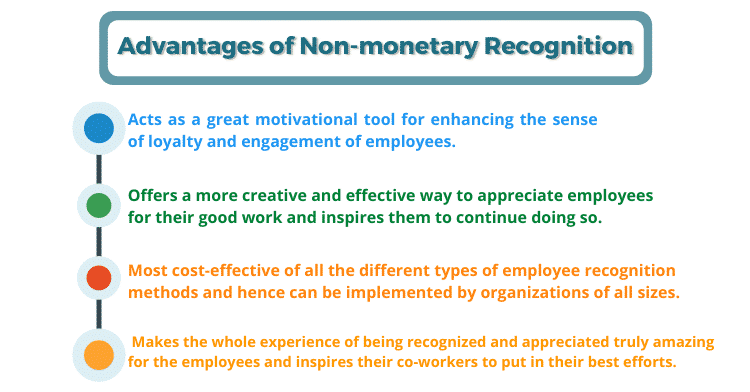
A study performed by the Incentive Research Federation for the Incentive Marketing Association has revealed that 65% of employees prefer non-monetary incentives over monetary rewards.
A lunch with the manager, a trip to the hill station, or an extra day off is likely to prove more impactful than any additional amount of money, as employees might not even remember what they spent it on.
To benefit from non-monetary recognition, organizations should research the available options.
While there are many ideas for non-monetary awards, not all would meet the recognition needs of an organization.
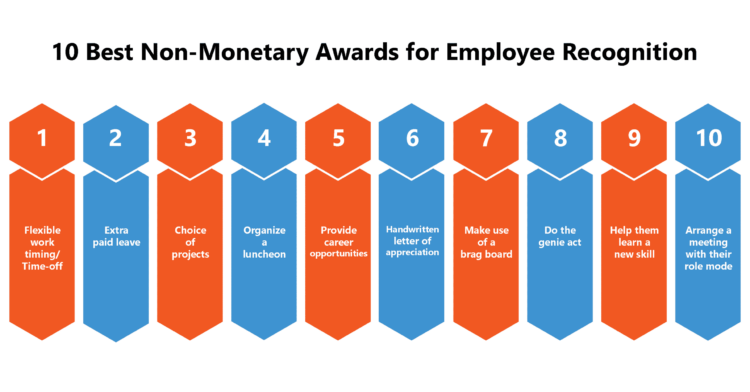
So, here are the ten best non-monetary award ideas that can be implemented by organizations irrespective of their size and operating model:
1. Flexible Work Timing/ Time-off
2. Extra Paid Leave
2. Extra Paid Leave
4. Use a Brag Board
5. Premium/ Reserved Parking
6. Choice of Projects/ Assignments
7. Special/ Cross-functional Initiatives
8. Training and Upskilling
9. Invite Family to the Office
10. Coffee/ Lunch with CEO

Most employees today strive to attain a work-life balance, hence providing them with the freedom to work flexible hours helps them to fulfill this objective.
It can be one of the most satisfactory ideas for employee recognition.

Providing employees with additional paid days can significantly enhance their happiness.
Spending more quality time with family and friends can enable them to relax and keep themselves motivated.

Rather than sending standard recognition emails, handwritten letters of appreciation from supervisors or leaders can be more effective.
It helps employees feel valued and fosters a sense of belonging through a personal touch.

Set up a board in the workplace where co-workers can leave short notes of appreciation for a specific duration.
Being recognized by peers can prove to be a great motivator.
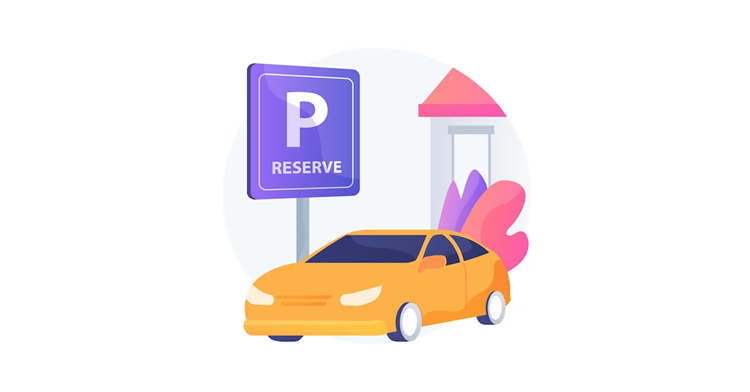
Providing premium or reserved parking at the office for a limited period can be a good reward for high-performing employees.
Such a privilege reminds the employee daily that the organization acknowledges and appreciates their contribution.
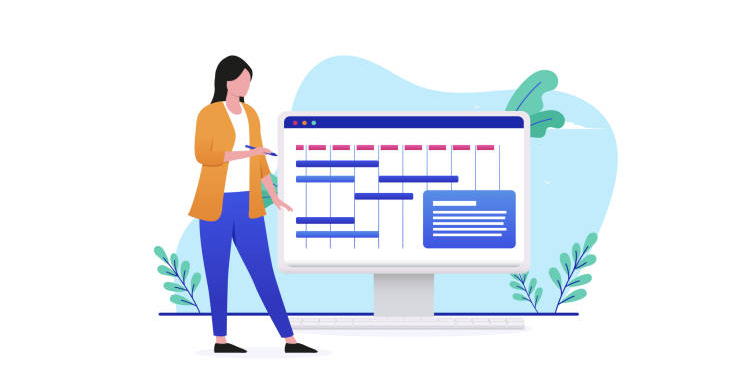
Another effective way to recognize the achievements of employees is to allow them to choose their next project.
In addition to making the employees feel genuinely appreciated, it strengthens their commitment to the organization.

Giving high-performing employees opportunities to participate in special or cross-functional initiatives could be another effective way of recognition.
It motivates the employees and helps them acquire additional skills and exposure to the organization.

To advance in their careers, employees must continually upgrade their skills and knowledge.
Hence, opportunities for skill development such as training programs or coaching can be an effective method of recognition.

One great way to recognize employees and build stronger emotional connections is to invite their families to the office to hear about their achievements and contributions from their supervisors and co-workers.
They can also have lunch with the supervisor and team at the office cafeteria.

Additionally, employees often draw inspiration from the CEO and senior management, who they consider role models.
Hence, arranging a one-on-one meeting or meal with a top executive can prove extremely gratifying and rewarding for the employee.

Recognition that doesn’t involve cash or financial incentives but provides value via time, privileges, experiences, or emotional impact.
They tend to be more memorable, build stronger emotional connections, and are often more cost-effective. Also, many employees prefer them for recognition.
Examples include flexible work schedules or time off, extra paid leave, handwritten appreciation letters, brag boards (places where colleagues post appreciation), reserved parking, choice of special projects, training and upskilling, inviting family to the office, or a meal/coffee with senior leadership.
Allowing employees to adjust their schedules or offering them time off to show appreciation. It helps improve work-life balance and is highly valued.
It’s personal and shows effort. Such letters from a supervisor or leader give employees a sense of belonging and of their contributions being genuinely appreciated.
A physical or digital space where coworkers leave short notes or messages recognizing the efforts or achievements of colleagues. Peer recognition that’s visible to all.
These rewards connect work to personal life and show senior leadership is engaged. They create emotional moments of recognition and elevated status.
Yes. Such awards foster satisfaction, a sense of being valued, and emotional connection—all of which contribute to retention, a stronger culture, and ongoing motivation.
Yes. Many of the ideas scale well and can be implemented even by smaller organizations without large budgets.
Consider what the employee values, align with your culture/values, ensure the reward is visible and meaningful, and mix in variety to keep recognition fresh.
Our suggestions on the best non-monetary awards can provide a cost-effective way for organizations to assure employees that they are truly valued and appreciated for their hard work and contribution. This, in turn, can enhance their sense of belonging and loyalty.

Lead author: Sagar Chaudhuri, the Co-Founder and CEO of HiFives. He is an HR Tech Evangelist with over 25 years of experience in both corporate and entrepreneurial settings. Previously, Sagar has held leadership roles at companies including Genpact, Infosys, and ICICI Bank. He has an engineering degree from IIT Kharagpur and an MBA from IIM Lucknow. Connect on LinkedIn
To stay updated on the latest HiFives blogs, follow us on Twitter (@MyHiFives)
Ready to transform employee recognition at your company?
See how leading companies use HiFives to boost engagement, retention and productivity.
Book a Free DemoChat on WhatsApp