


Non-monetary awards might work as well as, if not better than, monetary awards in motivating employees when done right.
1. Authenticity and Personal Connection: Non-monetary rewards, like handwritten notes or unique experiences, are perceived as more genuine, showing that the organization values employees as individuals.
2. Fosters a Sense of Belonging: These awards, such as special projects or recognition ceremonies, create a deeper connection to the organization and reinforce employees’ importance and value.
3. Reduces Workplace Discord: Unlike monetary rewards, non-monetary awards minimize unhealthy competition and comparisons, fostering a more positive and collaborative environment.
4. Enhances Employee Experience: Non-monetary rewards create lasting positive memories, boosting long-term motivation, engagement, and satisfaction among employees.
Most organizations have traditionally believed that monetary rewards guarantee the best results for driving employee engagement. However, the growing popularity of non-monetary awards in recent years is challenging that perception.
| Non-Monetary Awards | Best Practices | Impact on Engagement |
|---|---|---|
| Public Recognition (Shout-outs, Social Feeds, Town Halls) | Make recognition timely, specific, and visible across teams; enable peer-to-peer recognition | Builds a culture of appreciation, strengthens belonging, and boosts motivation and retention |
| Flexible Work Arrangements (Remote, Hybrid, Flexible Hours) | Offer flexibility based on role feasibility; allow employees to choose work styles | Improves work-life balance, productivity, and retention by empowering employees |
| Extra Time Off (Wellness Days, Early Leave, Birthday Off) | Provide surprise or performance-linked time off; align with wellbeing initiatives | Reduces burnout, improves morale, and sustains long-term productivity |
| Career Development Opportunities (Training, Mentorship, Stretch Roles) | Personalize learning paths; link recognition with growth opportunities | Enhances skill development, engagement, and long-term employee retention |
| Experiential Rewards (Events, Offsites, Unique Experiences) | Offer meaningful, memorable experiences aligned with employee interests | Creates a strong emotional connection and lasting impact compared to cash rewards |
| Autonomy & Ownership (Choice of Projects, Innovation Time) | Give employees freedom to choose tasks or work on passion projects | Drives innovation, intrinsic motivation, and a sense of ownership |
| Personalized Recognition (Handwritten Notes, Custom Gestures) | Tailor recognition to individual preferences and achievements | Makes employees feel genuinely valued, increasing emotional engagement |
| Wellness & Wellbeing Benefits (Mental Health Days, Fitness Support) | Integrate into regular programs; promote holistic employee wellbeing | Improves overall health, reduces absenteeism, and enhances productivity |
| Team Celebrations & Informal Events (Themed Days, Milestones) | Celebrate small wins and team achievements frequently and inclusively | Strengthens team bonding, collaboration, and workplace culture |
| Status-Based Recognition (Titles, Spotlight Features, Leadership Access) | Offer visibility, leadership exposure, or symbolic rewards (e.g., “Employee Spotlight”) | Reinforces achievement, boosts pride, and enhances employer branding |
| Peer-to-Peer Recognition Programs | Enable employees to recognize each other frequently via digital platforms | Increases participation, inclusivity, and a continuous recognition culture |
| Interest-Based Rewards (Hobby Support, Passion Projects) | Align rewards with personal interests or hobbies | Enhances personalization, satisfaction, and emotional connection with the organization |

Non-monetary awards can be as simple as saying ‘Thank you‘ or felicitating in a team meeting, sponsoring a training program, or even a particular assignment.
One study by Research Gate has also stated that non-monetary rewards ensure better motivation and long-term employee engagement as compared to monetary rewards.

As the name suggests, Non-Monetary Awards are those that do not offer a direct financial benefit to the employees.
They help enhance employees’ sense of pride and satisfaction with their performance and contributions to the organization.

These awards are symbolic and personal. Hence, they have a more profound impact on employees’ motivation and help strengthen their bond with the organization.
The budget does not constrain them, allowing them to be more creative and more frequent than financial awards would allow.

Studies have shown that non-monetary rewards can be more motivating for employees. They help in improving productivity and employee engagement significantly.
Hence, many organizations prefer these awards to appreciate and reward their employees for their excellent work.
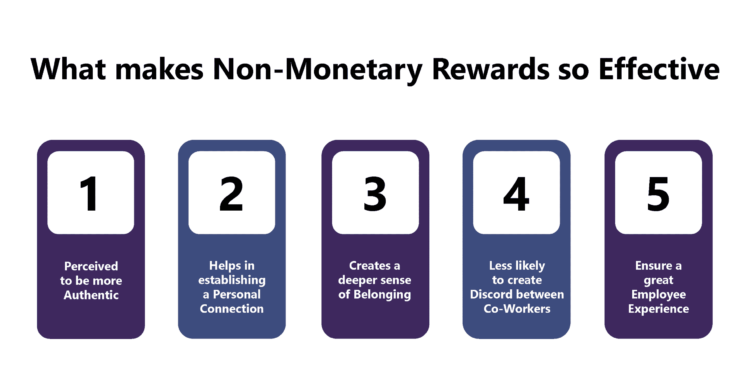
Let’s take a look at the possible reasons as to why Non-Monetary Awards work so well:
1. Perceived to be More Authentic
2. Helps Establish Personal Connection
3. Creates a Deeper Sense of Belonging
4. Less Likely to Create Discord between Co-Workers
5. Ensures Great Employee Experience

A non-monetary award, such as a handwritten ‘Thank You’ note, shows that the presenter has invested time and effort in rewarding the employee.
It adds much more value and meaning to the award in the recipients’ eyes.
They feel that their organization truly cares about them as individuals. This contributes greatly to boosting their motivation and performance.

Unlike monetary awards, non-monetary such as ‘Coffee with the CEO’ create a personal connection between the organization and the employees.
The organization considers employees’ needs and preferences while deciding on the award.
It is quite the opposite of giving away cash rewards, which tend to be more transactional and impersonal.

Non-monetary rewards, such as special projects or assignments, can foster a more profound sense of belonging to the organization.
Employees view these rewards as recognizing the organization’s efforts to ensure happiness and satisfaction.
These non-monetary rewards tend to symbolize that they are integral to the organization and that their contribution is much valued.

Monetary rewards can often create unnecessary comparisons and unhealthy competition among employees.
However, non-monetary awards, such as a training program or simply a day or time off, minimize such negative feelings among employees.
Non-monetary awards tend to be more inspiring for those who haven’t received the award.

Non-monetary awards create good memories of their presentation, the social recognition, or even the recipient’s pride.
These positive feelings can keep employees happy and motivated for a long time.
A big, well-organized award ceremony with the senior management, complete with selfies and video shoots can make the entire experience much more exciting and memorable for employees.
A virtual award ceremony can work as well if planned and managed correctly.
There are several reasons why non-monetary rewards are becoming popular with organizations. They are perceived as more effective than traditional monetary or cash awards.
Non-monetary rewards are likely to offer better results in terms of greater engagement, higher retention, and increased productivity.

Lead author: Sagar Chaudhuri, the Co-Founder and CEO of HiFives. He is an HR Tech Evangelist with over 25 years of corporate and entrepreneurship experience. In the past, Sagar has held leadership roles at companies such as Genpact, Infosys, and ICICI Bank. He has an engineering degree from IIT Kharagpur and an MBA from IIM Lucknow. Connect on LinkedIn
To stay updated on the latest HiFives blogs, follow us on Twitter (@MyHiFives)