


How organizations can conduct virtual employee awards ceremonies effectively, especially for a remote/ hybrid workforce.
1. Importance of Virtual Employee Awards Ceremonies: Virtual award ceremonies offer a safe and cost-effective way to recognize employees, foster team bonding, and share organizational updates, particularly in remote or hybrid work environments.
2. Critical Steps for Organizing a Virtual Ceremony: Successful virtual ceremonies require meticulous planning, choosing the right technology platform, modifying the event for online streaming, and effectively promoting it through a dedicated microsite.
3. Engaging the Virtual Audience: To maintain engagement, incorporate interactive elements such as Q&A sessions, audience polls, entertainment, and giveaways to keep participants involved and prevent drop-offs.
Want a rewards program your employees actually love?
See how leading companies use HiFives to boost engagement, retention and productivity.
Book a Free DemoChat on WhatsApp4. Need for Professional Tech Support: Engaging professional tech support ensures a smooth execution, helps manage the digital platform, and quickly resolves any technical issues that may arise during the event.
With work-from-home or remote work almost becoming the new normal, it’s no surprise that HR teams in many organizations are seeking the best ways to organize a virtual employee awards ceremony that meets the expectations of all employees.
Read about the Key Reasons to Digitize an Employee Recognition Program
| Key Areas | Best Practices | Business Impact |
|---|---|---|
| Event Planning & Coordination | Create a detailed event plan covering agenda, presenters, awardees, rehearsals, videos, and contingency measures | Ensures smooth execution and enhances overall employee experience |
| Choosing the Right Technology Platform | Select scalable, stable, and interactive platforms such as Teams, Zoom, Webex, or dedicated virtual event tools | Improves attendee participation, streaming quality, and engagement levels |
| Leadership Participation | Involve senior leaders in speeches, award announcements, and appreciation messages | Builds trust, improves employee morale, and strengthens organizational culture |
| Recognition Visibility | Publicly celebrate winners and achievements through live announcements, digital walls, and social feeds | Enhances employee motivation and creates aspirational value across teams |
| Audience Engagement | Include live polls, Q&A sessions, contests, chats, entertainment, and interactive activities | Reduces drop-offs and improves participation during virtual events |
| Professional Event Moderation | Use skilled anchors or emcees to maintain flow, excitement, and audience energy | Creates a polished experience and improves event effectiveness |
| Pre-recorded Content Integration | Blend live streaming with professionally edited videos, employee stories, and award presentations | Improves production quality and keeps the ceremony dynamic and engaging |
| Microsite or Central Event Hub | Create an internal microsite containing schedules, links, nominee details, and event updates | Simplifies communication and improves employee accessibility |
| Promotion & Internal Communication | Promote the ceremony through email, collaboration platforms, and internal social channels | Increases attendance, awareness, and employee excitement |
| Recognition for Remote & Hybrid Employees | Ensure equal visibility and participation opportunities for distributed employees | Strengthens inclusiveness and employee connection in hybrid workplaces |
| Entertainment & Informal Interaction | Add performances, stand-up comedy, music, games, or team interaction sessions | Improves engagement, bonding, and event memorability |
| Real-time Audience Interaction | Use live chats, reactions, polls, and virtual applause mechanisms | Creates a more immersive and participative employee experience |
| Technical Rehearsals & Dry Runs | Conduct mock sessions to test connectivity, transitions, presentations, and streaming quality | Minimizes disruptions and improves event reliability |
| Dedicated Tech Support | Use internal or external technical experts to manage backend operations and troubleshooting | Reduces technical risks and ensures seamless execution |
| Shorter & Engaging Event Format | Keep virtual ceremonies concise and fast-paced with smooth transitions | Prevents audience fatigue and improves retention during the event |
| Digital Awards & E-rewards | Provide digital certificates, e-gift cards, badges, or points-based rewards instantly | Enhances employee satisfaction and enables instant gratification |
| Storytelling & Employee Spotlights | Share impactful stories behind achievements and recognition moments | Creates emotional connection and reinforces organizational values |
| Gamification Elements | Introduce quizzes, leaderboards, participation contests, and surprise giveaways | Improves engagement and makes the event more interactive |
| Data-driven Participation Tracking | Measure attendance, engagement levels, poll participation, and employee feedback | Helps optimize future virtual events and improve ROI visibility |
| Cross-functional Participation | Encourage participation from all departments, levels, and geographies | Strengthens inclusiveness and organization-wide culture building |
| Recognition Aligned with Values | Link awards to organizational values, collaboration, innovation, and customer impact | Reinforces desired workplace behaviors and company culture |
| Accessibility & Ease of Joining | Ensure mobile-friendly access and low-friction joining processes for employees | Increases participation across frontline and distributed workforces |
| Post-event Communication | Share recordings, winner highlights, and event summaries after the ceremony | Extends engagement and amplifies recognition visibility |
| Cost-effective Recognition Experience | Leverage virtual formats to reduce venue, travel, and logistics costs | Improves scalability and delivers better ROI compared to physical-only events |
| Long-term Culture Building | Position virtual award ceremonies as recurring engagement and recognition initiatives | Strengthens employee engagement, retention, and organizational culture over time |
Over the last few years, organizations have digitized most of their HR processes, from recruitment and onboarding to training, engagement, performance management, and even exit interviews.
Employee recognition is one of the core HR processes that organizations have digitized already or are planning to digitize.

The annual employee awards ceremony has been an integral part of most organizations’ employee recognition programs.
It is an excellent opportunity for the organization to recognize and appreciate its high-achieving employees before the entire workforce, including senior management.
It is a hugely motivating and memorable occasion for the award winners and aspirational for all others.

Award ceremonies are great opportunities for business leaders to share updates on the latest developments and the roadmap of the business with the entire workforce.
These are also great for team bonding and for senior leaders to interact informally with employees across ranks on the sidelines of the event.

Conducting offline awards events might be logistically challenging for organizations with many remote employees in a hybrid work environment.
Given the importance of these events, several organizations go ahead and organize such award ceremonies virtually.

Organizing a virtual award ceremony has other benefits as well:
– Takes care of employee health and safety concerns
– Cost savings on physical venue, infrastructure, event management, logistics, and other related expenses.
– Shorter planning cycles and faster execution
However, virtually replicating the experience of an offline event is not easy.
Hence, organizations need to plan and execute such events properly to ensure that meet their objectives and expectations.
Hosting a virtual awards ceremony can present some pretty significant challenges.
Companies can best overcome these challenges by investing time and effort in proper event planning.
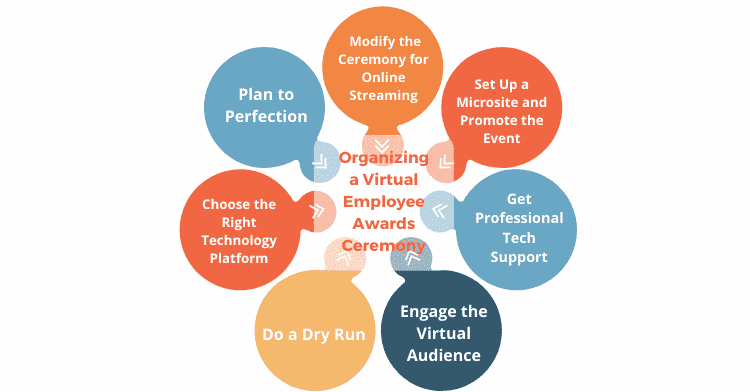
Here are a few tips:
1. Plan to Perfection
2. Choose the Right Technology Platform
3. Modify the Ceremony for Online Streaming
4. Set Up a Microsite and Promote the Event
5. Engage the Virtual Audience
6. Get Tech Support
1. Plan to Perfection

Organizing a live event, whether offline or online requires meticulous planning.
It is even more critical for an online event, as it will likely be shorter with no breaks.
Here are the key elements of the plan:
– Event Schedule
– Event anchors/ master of ceremonies
– Speakers and presenters
– Presentations and videos
– List of awardees

One of the most critical decisions in the planning of a virtual award ceremony is to choose the right technology platform.
Many factors would determine this choice:
– Scalability: based on the number of participants
– Bandwidth requirement: given that the network speed for participants might be different
– Stability: The platform should be reliable and not prone to crashes due to peak load
– Interactivity: the extent to which participants can get involved in the event
The organization could look at various options of technology platforms for organizing a virtual awards ceremony:
– Standard Web Conference Tools, including the enterprise editions of MS Teams, Zoom, WebEx, GoToMeeting, Google Meet, etc.
– Virtual Event Platforms such as BigMarker, GoToWebinar, HeySummit, SpotMe, vFairs, etc.
The organizing team should plan the event flow to make the transitions smoother and faster than offline events.
Unlike offline events, where transitions and breaks are inherent to the event flow, they are not feasible in virtual events.
Also, slideshows and pre-recorded videos of the presenters and awardees should be combined with the actual live streaming.
Professional editors might be required to create these videos to minimize the transitions.

It is a good idea to set up an event microsite for the virtual employee awards ceremony. The company could host it on the intranet or another internal platform.
The microsite can be given the look and feel of a virtual town hall or any other popular venue for hosting the ceremony.
Moreover, the microsite should serve as the central hub of information for participants, providing all relevant links and updates.
The organizers should also promote the virtual award ceremony via email, collaboration platforms, and internal social media to maximize employee participation.

Engaging a virtual audience is quite challenging as compared to an offline audience as they can easily log off or just ignore the event if they get bored.
Hence, the event organizers must plan for and facilitate audience participation.
It may include:
– Q & A sessions
– Audience chats
– Audience polls (before/ during/ after), Quizzes, and Contests
– Entertainment (live/ pre-recorded)
– Skits, Dance/ musical performances
– Stand-up comedy acts
– Audience giveaways/ prizes (e-gift cards/ vouchers)

Organizing a virtual employee awards ceremony without professional help can become a nightmare.
The organizers should rope in professionals with expertise and experience in digital/ streamed events, whether internal or external to manage the entire ‘backstage’ operations.
These experts can help select the right platform, set it up, and manage it during the event.
Also, they can quickly troubleshoot any technical issues that may arise.
Organizations need to get a grasp of how to organize a virtual employee awards ceremony effectively especially for a remote/ hybrid workforce. It can help organizations boost the morale and motivation of their workforce without compromising their health and safety.

Lead author: Sagar Chaudhuri, the Co-Founder and CEO of HiFives. He is an HR Tech Evangelist with over 25 years of experience in both corporate and entrepreneurial settings. Previously, Sagar has held leadership roles with companies such as Genpact, Infosys, and ICICI Bank. He has an engineering degree from IIT Kharagpur and an MBA from IIM Lucknow. Connect on LinkedIn
To stay updated on the latest HiFives blogs, follow us on Twitter (@MyHiFives)
Ready to transform employee recognition at your company?
See how leading companies use HiFives to boost engagement, retention and productivity.
Book a Free DemoChat on WhatsApp