


Recognizing employees for their contributions to community service demonstrates that the organization cares about the greater good and encourages direct involvement in such initiatives.
1. Enhances Employee Skills and Morale: Recognizing employees for community service improves teamwork, innovation, leadership, and interpersonal skills, boosting morale and motivation.
2. Strengthens Organizational Culture: Encouraging community service fosters a culture of collaboration and empathy, leading to a supportive and harmonious work environment.
3. Improves Organizational Reputation: Acknowledging social contributions enhances the organization’s reputation as a responsible corporate citizen, building goodwill with stakeholders.
4. Promotes Corporate Social Responsibility: Such recognition demonstrates the organization’s commitment to societal betterment and encourages similar values among its workforce.
Organizations today are increasingly aware of their responsibility to contribute to society and the broader community. Many organizations offer financial and material assistance. Others encourage their employees to participate in community service. Should organizations recognize employees for community service?
| Key Reasons | Best Practices | Business Impact |
|---|---|---|
| Reinforce Purpose & Social Impact | Recognize employees who contribute to social causes and connect recognition to organizational values and CSR goals | Builds a strong sense of purpose and meaning at work, increasing engagement |
| Drive Participation in CSR Initiatives | Introduce structured volunteering programs and reward participation through points, awards, or recognition platforms | Improves participation rates in CSR and strengthens employee involvement |
| Promote a Values-Driven Culture | Align recognition with behaviors like empathy, community service, and sustainability | Embeds organizational values into daily behavior and culture |
| Enhance Employer Brand & Reputation | Publicly celebrate employee contributions via internal platforms, social media, or company communications | Strengthens brand image and positions the company as socially responsible |
| Encourage Team Collaboration Through Volunteering | Recognize team-based community initiatives and group volunteering efforts | Improves teamwork, collaboration, and cross-functional bonding |
| Boost Employee Engagement & Morale | Provide frequent and meaningful recognition for social contributions, not just business outcomes | Increases morale, motivation, and overall workplace satisfaction |
| Enable Personal Fulfillment & Well-being | Allow employees to support causes they care about and recognize those contributions | Improves emotional well-being, pride, and connection to the organization ( |
| Make Recognition Visible & Social | Highlight community efforts through leaderboards, the Wall of Fame, and storytelling | Inspires others to participate and amplifies impact across the organization |
| Integrate Recognition with Rewards & Donations | Allow employees to convert recognition points into charitable donations or CSR-linked rewards | Aligns rewards with purpose and increases the perceived value of recognition |
| Measure and Scale CSR Engagement | Track participation, impact, and recognition metrics through dashboards and analytics | Enables data-driven CSR strategy and improves long-term program effectiveness |

Traditionally, organizations have been recognizing employees for their efforts, contributions, and achievements that help in driving business growth.
More recently, employee recognition programs have included specific behaviors that positively impact other organizational values, such as collaboration, innovation, integrity, etc.
Hence, many progressive organizations have started recognizing their employees who participate in community outreach programs,
When recognizing employees for community service, organizations must justify their decisions.
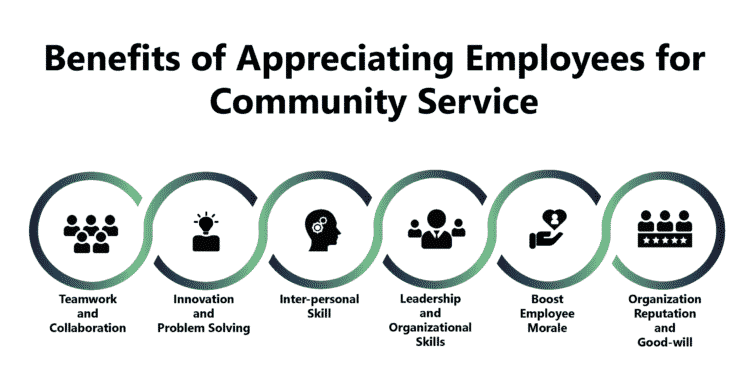
The most important benefits of such initiatives are as follows:
1. Improves Teamwork and Collaboration
2. Encourages Innovation and Problem Solving
3. Builds Interpersonal Skills
4. Enhances Leadership and Organizational Skills
5. Boosts Employee Morale
6. Improves the Organization’s Reputation and Goodwill

Encouraging employees to volunteer for community service can help improve coordination and cooperation among coworkers.
Volunteering teaches employees the art of giving without expecting anything in return and gradually the habit can become an integral part of their personalities.
Additionally, it would inspire other employees to volunteer, which, over time, would become part of the organization’s work culture.
It helps ensure coworkers are more willing to support one another, fostering a work environment built on coordination and collaboration.

Employees might also have opportunities to apply their technical expertise and creative thinking to address the practical challenges of community work.
It too can have a positive impact on their performance at work and help in business growth.

Employees who volunteer for your community services develop better interpersonal skills. They must deal with individuals with diverse personalities, temperaments, and backgrounds.
Employees can empathize with the people they are trying to serve.
They learn to deal with different types of people with greater patience and confidence, which translates into their interactions with difficult colleagues at work.
Hence, it helps build conflict-management skills and fosters a more peaceful and harmonious work environment.

Most organizations recognize the importance of identifying potential leaders and developing them for more senior roles.
Employees volunteering for social service often exhibit the key traits that the organization would look for in a good leader.
These include effective communication and interpersonal skills, the ability to motivate others, and the confidence to take initiative and overcome challenges.
Organizations can then nurture potential leaders to take up key organizational positions in the future through proper guidance, mentoring, and support.

When employees are recognized for doing something that benefits society rather than just themselves or the organization, they feel the organization truly values and appreciates them as individuals.
Hence, it helps in boosting their morale and improves their sense of self-worth. It helps them earn the respect of their co-workers and society at large.
It helps improve employees’ overall motivation, which can positively impact their performance and efficiency at work.

When an organization recognizes its employees for their social work, it sends a strong positive message to the entire professional community.
Such gestures are reflective of the fact that the organization takes its corporate social responsibility very seriously and promotes similar behavior by the members of its workforce.
Hence, it positively impacts the organization’s perception among its customers, business partners, suppliers, and other stakeholders.
So, they perceive the organization as a responsible corporate citizen. It enhances its market credibility and goodwill.
Recognizing employees for their contribution towards community service goes to show that the organization too cares for the greater good of society and encourages its employees to be directly involved in such initiatives.

Lead author: Sagar Chaudhuri, the Co-Founder and CEO of HiFives. He is an HR Tech Evangelist with over 25 years of experience in both corporate and entrepreneurial settings. Previously, Sagar has held leadership roles with companies such as Genpact, Infosys, and ICICI Bank. He has an engineering degree from IIT Kharagpur and an MBA from IIM Lucknow. Connect on LinkedIn
To stay updated on the latest HiFives blogs, follow us on Twitter (@MyHiFives)