

Does employee rewards & recognition make sense in a sales organization — unlock strategic insights for designing programs that drive motivation, nurture team synergy, and boost revenue.
1. Sales teams need more than just incentives; recognition and rewards are crucial for maintaining motivation, especially during challenging periods.
2. Integrating rewards and recognition with compensation plans fosters lasting motivation, commitment, and enhances overall performance.
3. Offering a variety of rewards beyond cash, such as gadgets or holidays, helps keep the motivation fresh and relevant.
4. Recognizing individual and team efforts fosters a healthy balance of competition and collaboration, which are essential for the sales organization’s overall success.
Most sales-driven organizations already have well-developed incentive programs for their sales executives. However, these incentives alone may not be enough to motivate the sales representatives, as they often do not acknowledge or appreciate their efforts or dedication.
| Key Reasons | Why It Matters | Best Practices | Business Impact |
|---|---|---|---|
| Boosts motivation in high-pressure environments | Sales roles are target-driven and emotionally demanding; recognition sustains energy and morale | Combine monetary incentives with frequent recognition (daily/weekly wins) | Higher motivation and sustained performance levels |
| Engages the mid-level performers | Not just top performers, but the mid-tier salesforce drives the majority of revenue | Design tiered incentives and recognition for incremental achievements | Significant revenue uplift from broader team activation |
| Balances intrinsic and extrinsic motivation | Sales teams respond to both financial rewards and emotional recognition | Use a mix of incentives (bonuses, commissions) and social recognition (leaderboards, shoutouts) | Improved engagement, satisfaction, and long-term performance |
| Reduces burnout and attrition | Continuous pressure and rejection can lead to fatigue; recognition provides emotional reinforcement | Recognize effort, not just outcomes (e.g., pipeline building, client engagement) | Lower attrition and stronger resilience in sales teams |
| Encourages healthy competition and collaboration | Recognition creates visibility and healthy competition while reinforcing teamwork | Use gamification (leaderboards, badges) and team-based rewards | Increased productivity and team alignment |
| Improves clarity of goals and expectations | Recognition tied to specific outcomes helps sales reps understand what success looks like | Make recognition specific, timely, and linked to measurable achievements | Better goal alignment and consistent performance |
| Strengthens engagement and commitment | Feeling valued increases emotional connection to the organization | Enable peer-to-peer and manager-led recognition in real time | Higher engagement, loyalty, and discretionary effort |
| Enhances customer-centric behaviors | Recognizing behaviors like relationship-building and service quality improves long-term sales success | Reward not just deals closed, but behaviors like upselling, retention, and customer satisfaction | Improved customer loyalty and lifetime value |
| Strengthens cross-functional teamwork and collaboration | Sales success depends heavily on coordination with marketing, product, customer success, and operations | Introduce team-based and cross-functional recognition; reward collaborative wins (e.g., deal closures involving multiple teams) | Improved alignment, faster deal cycles, and better customer outcomes |
| Creates a performance-driven culture | Continuous recognition embeds high-performance norms into the sales culture | Integrate R&R into daily workflows (CRM, sales tools, communication platforms) | Stronger performance culture and scalable growth |
On the other hand, providing appropriate rewards and recognition can help motivate the sales team, especially during periods of low sales.
This is why organizations today are considering creating effective rewards and recognition programs for their sales teams in parallel to the existing compensation systems.

Sales is a critical business process as it directly impacts cash flows and provides vital information about customer needs and expectations.
The front-line sales team of any business is the face of the organization in the marketplace.

Apart from managing constant competitive pressures, they must understand customers’ changing preferences and buying processes.
These factors tend to put tremendous stress on sales team members and impact their morale and motivation.
This is why organizations should have effective reward and recognition programs to keep them constantly motivated.

The most important thing companies need to understand is that all sales representatives’ activities are purpose-driven.
Unlike cash incentives and bonuses, focused recognition and rewards tend to be more effective as they are perceived to be more personal and memorable.
Publicly appreciating their efforts to nurture client relationships, collect information, share insights, and collaborate with other team members can drive their motivation to new heights.
Investing in employee rewards can motivate sales representatives to expand the business’s market share and enhance customer retention.
A great employee rewards and recognition program for sales representatives is essential for creating a successful organization.
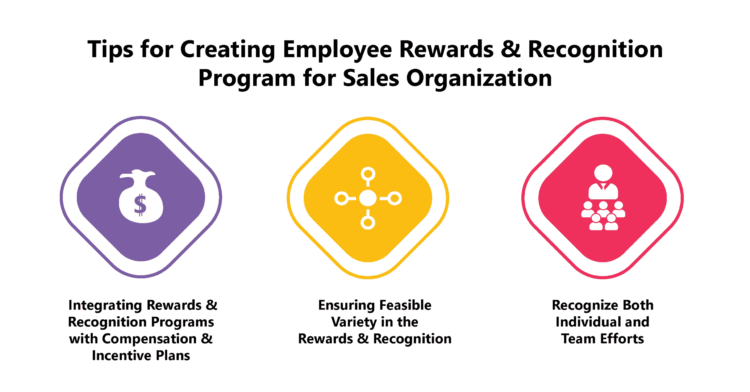
However, it is crucial to consider certain critical factors while creating such a system that offers the desired results:
1. Integrate Rewards and Recognition Programs with Compensation and Incentive Plans
2. Ensure Feasible Variety in the Rewards and Recognition
3. Recognize Both Individual and Team Efforts

Like other employees, the sales team can benefit from rewards and recognition throughout the year.
However, ensuring that these programs integrate with the existing compensation and incentive plans is essential.
Relying solely on either the compensation and incentive plans or just the R&R systems can only provide temporary benefits. Integrating the two can bring about a lasting change in the attitude and behavior of sales representatives.
It would also enhance employee motivation, dedication, and organizational commitment.

Most organizations believe that cash rewards and certificates of appreciation are the most effective ways to motivate sales teams.
However, they overlook that such a system tends to grow monotonous and dull over time. Sales representatives often compare the cash rewards to the yearly bonuses or incentives they receive.
Hence, sales organizations need to ensure a feasible variety in the rewards and recognition for their sales teams.
It may take the form of gadgets, holidays, or gift vouchers that sales professionals might find appealing.

Organizations often make the mistake of creating R&R programs that focus solely on appeasing individual sales representatives.
Or they focus only on the collective efforts of entire teams. These approaches may not be practical, as they consider only one aspect of the overall sales process.
In any sales-driven organization, the contribution of individual employees is almost as important as that of entire teams. Hence it is important to have a program that rewards and recognizes both individuals and teams.
It helps promote healthy competition among team members while encouraging them to work together as a single unit.

Yes — beyond commissions and incentives, recognition helps sustain motivation, especially during slow periods or when targets are challenging.
Incentives alone may ignore day-to-day effort and commitment. Recognition makes contributions feel seen and valued in personal, memorable ways.
Recognition and incentives should work together. Recognition programs should complement, not replace, compensation and incentive schemes to deliver lasting motivation.
Variety is key — beyond cash, use gadgets, holidays, gift vouchers, and other tangible perks to keep recognition fresh.
Both. Recognizing individual contributions encourages healthy competition, while team recognition fosters collaboration and a sense of collective responsibility.
Behaviors beyond closing deals — e.g., nurturing customer relationships, sharing insights, collaboration, consistency, and seeding work that supports long-term growth.
Recognition feels more personal and enduring. Unlike monetary rewards that may be compared or expected, a well-timed acknowledgment carries emotional value.
A thoughtfully designed recognition program is crucial for sales organizations—it boosts morale, enhances motivation, and drives sustainable performance beyond just incentive payouts.
A well-defined and properly thought-through rewards and recognition program is essential for ensuring the growth and success of a sales-driven organization. Such a program can ensure a higher level of satisfaction and motivation of their sales representatives and deliver business impact well beyond just sales incentives!
.

Lead author: Sagar Chaudhuri, the Co-Founder and CEO of HiFives. He is an HR Tech Evangelist with over 25 years of experience in both corporate and entrepreneurial settings. Previously, Sagar has held leadership roles with companies such as Genpact, Infosys, and ICICI Bank. He has an engineering degree from IIT Kharagpur and an MBA from IIM Lucknow. Connect on LinkedIn
To stay updated on the latest HiFives blogs, follow us on Twitter (@MyHiFives)