


These tips for giving negative feedback to employees can help supervisors, who often feel extremely stressed when doing so.
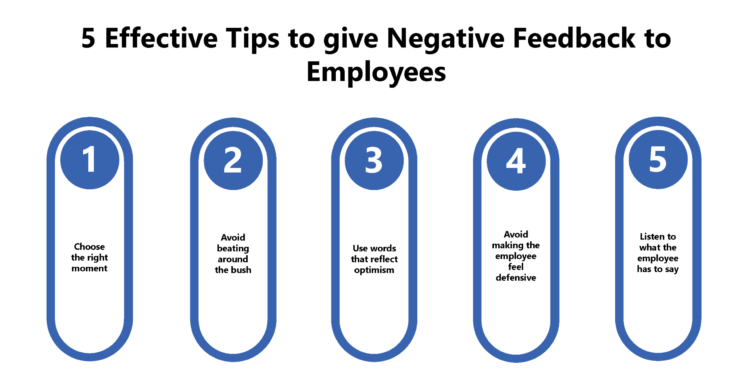
1. Choose the Right Moment: Deliver feedback privately and appropriately to ensure it is well-received. Avoid providing feedback when emotions are high.
2. Be Direct and Specific: Clearly state the employee’s shortcomings without sandwiching them between excessive positive comments, which may dilute the message.
3. Use Optimistic Language: Frame feedback in a positive light, focusing on growth and future improvement to encourage a more receptive and action-oriented response.
Want a rewards program your employees actually love?
See how leading companies use HiFives to boost engagement, retention and productivity.
Book a Free DemoChat on WhatsApp4. Balanced Approach: Don’t focus only on the negative aspects and make the employee feel defensive.
5. Encourage Dialogue: Allow employees to share their perspectives and listen actively. It can provide valuable insights and foster a constructive conversation.
Giving feedback is a crucial managerial responsibility that, when done correctly, can enhance employee engagement and motivation. While most find it easy to offer positive feedback to employees, they often feel challenged to provide negative feedback.
Hence, it is unsurprising that providing negative feedback often makes managers feel as though they are wading into extremely delicate territory.
They are unsure about the impact of such corrective feedback on employees’ motivation.
Most managers believe that negative feedback will demotivate employees and may ultimately lead them to leave.
Here are a few practical tips to give negative feedback to employees that would help managers:

Such fears among managers often stem from offering negative feedback without much thought or preparation.
While most employees are willing to receive constructive feedback, it must be delivered appropriately to achieve the desired outcomes.
If delivered inappropriately, employees would be less receptive to even constructive criticism. On the other hand, providing negative feedback correctly can be a potent tool for personal development and performance improvement.
Most managers are unsure of the most effective way to deliver negative feedback.
Here are five practical tips that can help managers turn this seemingly tricky situation into a favorable one:

Choosing the right moment to give constructive feedback is crucial. Managers should release their initial negative emotions toward the employee by providing feedback.
Ensuring that managers hold such conversations privately and one-on-one is also essential. Highlighting their concerns logically before the employee is key to turning the conversation positive and achieving the desired outcomes.

The most effective way to deliver negative feedback is by sandwiching it between positive comments about the employee. However, this approach may result in the employee completely ignoring the corrective feedback and focusing only on the positive comments.
So, rather than beating around the bush, the manager should directly detail the employee’s shortcomings. It ensures that the employee fully understands the outcomes of their performance assessment and the required corrective actions.

The choice of words and tone when delivering negative feedback can significantly impact how the employee perceives it. Using language that reflects optimism and confidence in employees is more likely to yield positive results.
The manager should focus on the employee’s achievements rather than their faults and drawbacks. Using growth-oriented language stimulates behavior changes and makes employees more inclined to act.
For example, if you focus more on unit testing, you will spend less time on rework. Your modules will be completed faster.

It typically occurs when the manager focuses more on employees’ shortcomings than on the observed behavioral issues.
When faced with such direct criticism, employees tend to focus on counterarguments rather than genuinely understanding the feedback. It naturally proves counterproductive.

When providing negative feedback, the manager should allow the employee to express their views. They should listen attentively to what employees have to say, without interrupting them unless necessary.
This simple initiative can significantly enhance the effectiveness of performance management. It will help managers understand the personal or professional factors that may affect an employee’s performance.
This data can help take corrective measures to improve employee performance and ensure growth and development.
One of the most important things for managers to remember while delivering negative feedback to employees is to reaffirm their confidence in them. The managers should never cast any doubt on the commitment of the employee to his or her job and to the organization.
They should then steer the discussion toward a positive outcome, despite the negative feedback. Hopefully, these tips for giving negative feedback will be helpful to managers.

Lead author: Sagar Chaudhuri, the Co-Founder and CEO of HiFives. He is an HR Tech Evangelist with over 25 years of experience in both corporate and entrepreneurial settings. Previously, Sagar held leadership roles at companies including Genpact, Infosys, and ICICI Bank. He holds a bachelor’s degree in engineering from IIT Kharagpur and an MBA from IIM Lucknow. Connect on LinkedIn
To stay updated on the latest HiFives blogs, follow us on Twitter (@MyHiFives)
Ready to transform employee recognition at your company?
See how leading companies use HiFives to boost engagement, retention and productivity.
Book a Free DemoChat on WhatsApp