


Embedding recognition into managerial goals is no longer optional — it’s a strategic imperative for engagement, performance, and retention.
– Recognition is not a “soft lever” — it’s a strategic business driver that impacts engagement, retention, and performance.
– When left informal, it becomes inconsistent and undervalued.
– Embedding recognition into a manager’s KRA ensures accountability, fairness, and alignment with the organization’s culture.
Want a rewards program your employees actually love?
See how leading companies use HiFives to boost engagement, retention and productivity.
Book a Free DemoChat on WhatsApp– Use a mix of coverage, timeliness, quality, impact, equity, and storytelling metrics to design recognition KRAs.
– Pilot, iterate, and scale with technology and manager training support.
Many organizations relegate recognition to a “nice to have” — an occasional pat on the back or an email sent at random. But that mindset undermines its real potential. When organizations do not formally embed recognition in a manager’s goals (KRAs), it becomes sporadic, inconsistent, or neglected altogether. The result? Missed opportunity, disengagement, and preventable turnover.
In this article, we unpack why recognition deserves a permanent place in every manager’s KRA and how to operationalize it in a measurable, fair, and high-impact way.
| Key Reasons | Best Practices | Business Impact |
|---|---|---|
| Ensures accountability for recognition | Include recognition metrics (coverage, frequency, timeliness) in manager KRAs and performance reviews | Drives consistency and ensures recognition is not ignored or deprioritized |
| Improves employee engagement | Encourage frequent, real-time recognition and embed it into daily workflows | Higher engagement, motivation, and discretionary effort |
| Reduces bias and favoritism | Track recognition distribution across teams, roles, and demographics; ensure equitable recognition practices | Builds trust, fairness, and an inclusive workplace culture |
| Drives consistency in people management | Standardize recognition expectations across all managers with clear guidelines and KPIs | Creates a uniform employee experience across teams and locations |
| Reinforces desired behaviors and values | Link recognition to company values, behaviors, and business goals | Encourages repeatable high-performance behaviors and culture alignment |
| Improves retention and reduces attrition | Make recognition frequent, meaningful, and personalized; track its correlation with retention metrics | Lower voluntary turnover and stronger employee loyalty |
| Enhances manager effectiveness | Train managers on how to give meaningful, timely, and specific recognition | Builds stronger manager-employee relationships and leadership capability |
| Drives measurable business outcomes | Track recognition impact on engagement, productivity, and performance through analytics | Improved productivity, performance, and overall business results |
| Ensures the timeliness of recognition | Define SLAs (e.g., recognition within 5–7 days of achievement) as part of KRAs | Maximizes behavioral reinforcement and the impact of recognition |
| Makes recognition strategic, not optional | Integrate recognition into formal performance management systems and goal-setting processes | Elevates recognition from a “nice-to-have” to a core driver of business success |

Here are a few findings from industry studies:
– 25% of employees quit their jobs because their efforts are not recognized.
– 5 out of 10 managers scored very low on recognition, resulting in a drop in overall employee engagement.
– Recognition not only boosts individual employee engagement but also increases productivity and loyalty.
Here is a summary of key rationale, supported by data, literature, and real-world insights:
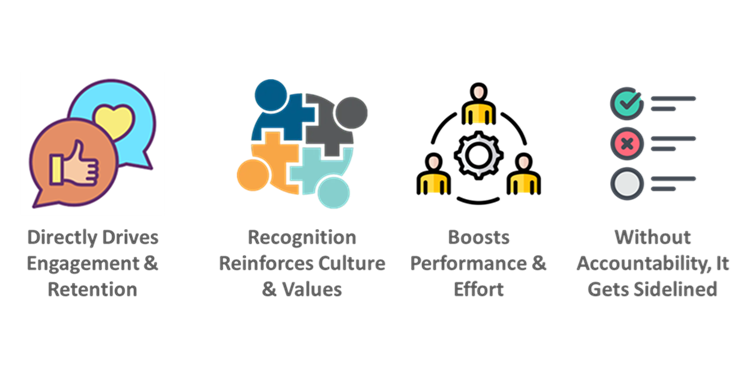
Employees who feel recognized are 3–4× more engaged and much less likely to leave.
– A recognition-focused longitudinal study by Workhuman / Gallup found that employees who received high-quality recognition were 45% less likely to leave over a multi-year period.
– Leadership recognition dropped from 20% to 15%, and weekly employee recognition declined from 29% to 19% (Achievers Workforce Institute) — a recognition recession that correlates with declining loyalty.
– Because managers account for up to 70% of team engagement variance (Gallup), leaving recognition as an afterthought undermines retention and morale.
Managers are the front line of culture.
If recognition is part of their formal KRA, it sends a clear signal: “We value how you make others feel, not just what you deliver.”
Embedding appreciation into performance goals helps institutionalize the behaviors you want repeated (e.g., teamwork, customer focus, empathy) rather than leaving recognition to ad hoc.
Positive reinforcement encourages repeat behavior.
Frequent, meaningful recognition nudges employees to go the extra mile, suggesting that recognition is itself a performance lever, not a soft “nice to have.
Jean-Pierre Brun’s classic framework identifies four forms of recognition — personal, results, work practice, and dedication — and highlights how recognition is as much an organizational management issue as a psychological one. ResearchGate
If it’s not in the KRA, managers rarely prioritize it. Recognition left to “good intentions” tends to be inconsistent, biased, or forgotten under pressure.
Embedding recognition in manager-level KRAs ensures fairness, consistency, and accountability.
In one HR forum, a manager shared:
“We ran an employee engagement survey … found many employees unhappy with their managers for low recognition.“

Here is a tactical framework for designing KRAs around recognition (with sample metrics). Use this as a starting template, and calibrate to your context.
| Dimension | Sample Metric / KRA Component | Why It Matters | Target Guideline* |
| Coverage / Frequency | % of direct reports given recognition in a quarter (e.g., ≥ 80%) | Ensures recognition isn’t concentrated only on a few | ≥ 75–90% |
| Timeliness | % of recognitions given within X days (e.g., ≤ 7 days from the event) | Recognition delayed loses impact (dopamine/reinforcement) | ≥ 80–90% |
| Quality / Sentiment | Average “meaningful recognition” rating via peer/team surveys | To avoid superficial “good job” notes | ≥ 4/5 |
| Impact / Outcome | Correlation of recognition with retention, engagement, and productivity | Connects recognition to business outcomes | Positive correlation; reduced attrition vs baseline |
| Equity & spread | Balance across gender, function, and experience levels | Prevents favouritism | < 10% variance across demographics |
| Narrative / Storytelling | Managers must share 1–2 recognition stories/cases per quarter | Encourages thoughtful, story-based recognition | “Best example of recognition-driven outcome” |
* These guideline targets are illustrative. Each organization should calibrate based on its scale, maturity, and culture.
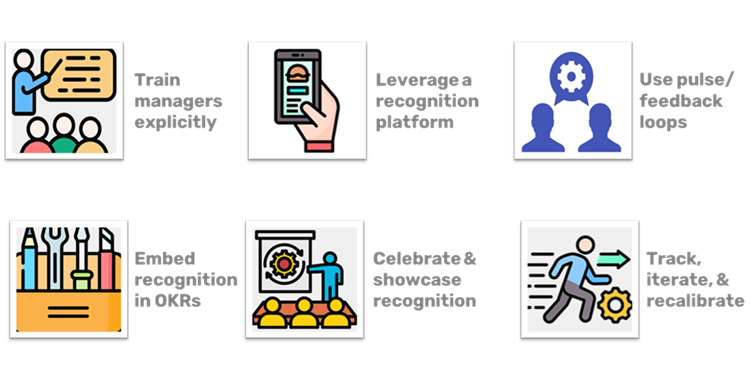
1. Train managers explicitly in recognition skills — how to give meaningful, timely, inclusive appreciation to their team members.
2. Leverage a recognition platform for instant recognition, nominations, nudges, and dashboards.
3. Use pulse/engagement feedback loops to monitor whether employees feel seen and valued.
4. Embed recognition in OKRs too — e.g., “Objective: Foster a culture of appreciation; Key Result: Manager recognition uptake ≥ 85%.”
5. Celebrate and showcase good recognition – in a team meeting or a digital “recognition hall of fame” to inspire their peers.
6. Iterate and recalibrate — run A/B pilots, track data, and evolve metrics over time.
Before launching this initiative, run through this checklist:
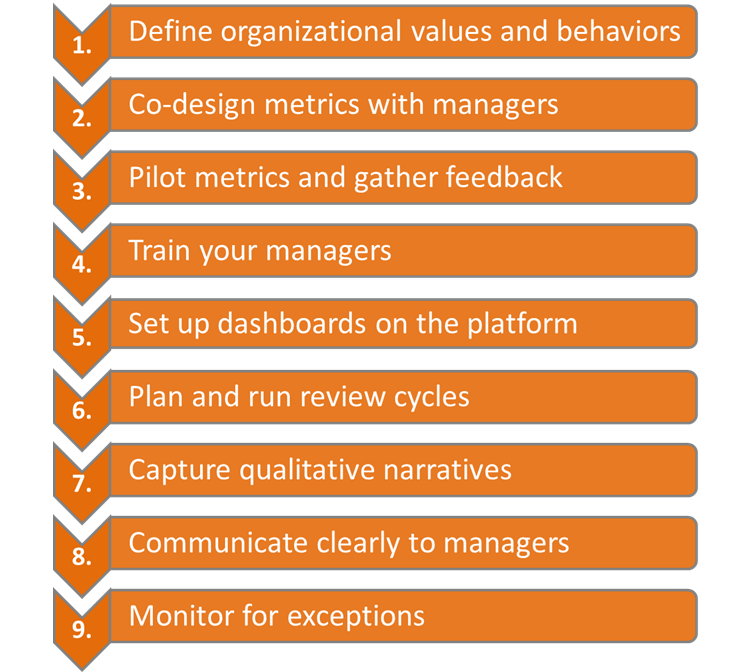
1. Define your organizational values and behaviors that recognition should reflect
2. Co-design recognition metrics with managers (ownership matters)
3. Pilot metrics and gather feedback from managers and teams
4. Train managers on both giving and receiving recognition
5. Set up dashboards/alerts/nudges via your recognition platform
6. Plan review cycles (quarterly, biannually) to refine metrics
7. Capture qualitative narratives (stories) to complement metrics
8. Communicate clearly to managers: “Your KRA now includes one vital people metric.”
9. Monitor for unintended consequences (e.g., gaming, frequency over quality)

The organization could frame recognition as a multiplier — better morale, less rework, fewer exits — which feeds into results. Also, recognition need not be time-intensive; simple, well-crafted acknowledgment works well.
Yes, which is why including a quality or sentiment metric is critical (via ratings or surveys). Also, calibration (peer review) can weed out low-value recognition.
Depends on the organization’s maturity. You might start low (5–10%) and scale to 20%+ if culture shifts and data justify it.
Use cascaded metrics (for direct reports and via mid-managers) or proxy metrics, such as “manager recognition adoption rate,” instead of individual recognition counts.
At least semi-annually. Recognition practices and frequency often evolve; regular feedback loops are key.
Recognition isn’t a feel-good activity — it’s a measurable business lever that directly impacts engagement, retention, and performance. Embedding recognition into every manager’s KRA ensures accountability, fairness, and culture alignment. By tracking the right metrics, training managers, and leveraging digital tools, organizations can transform recognition from a sporadic gesture into a sustained, strategic driver of performance and loyalty.

Lead author: Sagar Chaudhuri, the Co-Founder and CEO of HiFives. He is an HR Tech Evangelist with over 25 years of experience in both corporate and entrepreneurial settings. Previously, Sagar has held leadership roles with companies such as Genpact, Infosys, and ICICI Bank. He has an engineering degree from IIT Kharagpur and an MBA from IIM Lucknow. Connect on LinkedIn
To stay updated on the latest HiFives blogs, follow us on Twitter (@MyHiFives)
Ready to transform employee recognition at your company?
See how leading companies use HiFives to boost engagement, retention and productivity.
Book a Free DemoChat on WhatsApp