

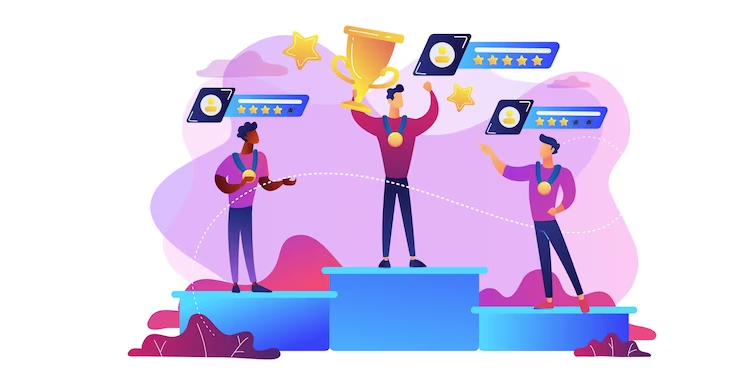
Gamification of work activities can turn workplaces into vibrant and productive work environments with happy and engaged employees
Definition of Gamification: Gamification involves applying game elements in non-gaming environments, such as the workplace, to drive engagement by tapping into motivations such as recognition, competition, and rewards.
Benefits of Gamification: It provides real-time feedback, increases transparency through scoreboards, and makes work more enjoyable, enhancing employee engagement, productivity, and satisfaction.
Implementation Strategy: Effective implementation requires understanding employee needs, establishing a business case, involving all stakeholders, and regularly measuring and refining the program.
Want a rewards program your employees actually love?
See how leading companies use HiFives to boost engagement, retention and productivity.
Book a Free DemoChat on WhatsAppContinuous Improvement: Regularly assess outcomes using key performance indicators (KPIs) and adjust the program based on stakeholder feedback to maximize effectiveness.
Driving higher levels of employee engagement is becoming a significant challenge for organizations worldwide. One effective strategy for enhancing employee engagement is implementing gamification.
Organizations can use it to motivate and empower their underperforming workforce, improving productivity and performance.
Research has shown that gamification in organizations can enhance engagement, productivity, and happiness of the workforce by more than 80%.

Contrary to popular belief, gamification is not about turning a workplace into an arena for playing games.
Gamification is about using elements of gaming in a non-gaming environment such as business to drive workforce engagement.
It focuses on human psychology to drive engagement and uses technology to apply these insights in a business environment.

It taps into common motivators, such as recognition, competition, and rewards, and leverages game elements like collaboration, opportunities, and progression.
Gamification is one of the few engagement strategies that can be used across key areas within an organization.

Implementing gamification can provide great benefits for organizations.
Hence, it is a popular choice for transforming workplaces with large numbers of millennials.

The most important of these benefits is listed as follows:
1. It offers real-time feedback, as employees don’t have to work toward annual goals. Instead, they can work toward real-time, measurable, and meaningful targets, much like a game.
2. Gamification helps eliminate fears of favoritism by making the system transparent through the use of gaming scoreboards and leaderboards.
3. Since psychology is integral to gamification, it makes work-life more enjoyable, as if the employees are playing a game.
The concept of gamification within a business environment is slightly more complicated than creating a rewards program.
Organizations should design it strategically to cater to the distinct employee dynamics within a specific work environment.
That is why it is essential to consider the following critical steps for successful implementation:
1. Understanding employee needs
2. Establishing the business case
3. Ensuring the involvement of all stakeholders
4. Measuring progress – repeat and refresh
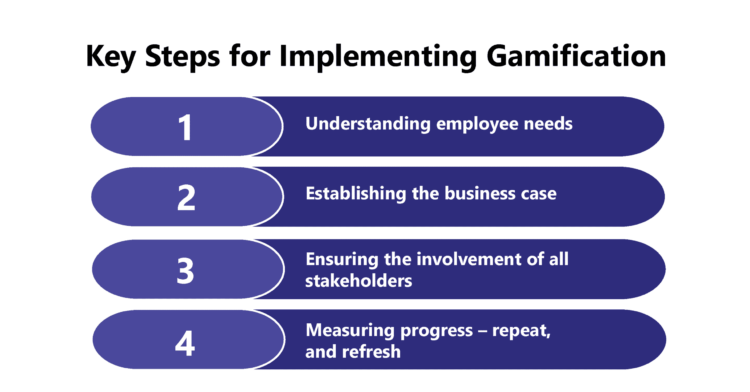

Implementing an engagement strategy with gamification requires careful consideration of employees’ needs, goals, preferences, aspirations, and behaviors.
Obtaining this information provides an organization with the necessary insights for identifying issues that gamification needs to address.
It, in turn, helps the organization to clearly define the basic framework for designing and implementing the concept.
Organizations must also define employee behaviors concerning the processes for effectively integrating gaming elements.

Establishing a robust business case is essential to successfully developing and implementing a workplace gamification program.
Hence, this requires proper identification of organizational goals for gamification, the key metrics, and the business impact.
Therefore, organizations need to define the expected changes in employee motivation, behavior, and attitude that the program is intended to bring about.
It is essential to define KPIs relevant to the gamification process and the expected return on investment.

Implementing the gamification program requires cooperation from various stakeholders within the organization.
So, ensuring the active involvement of various stakeholders is essential to achieving the desired outcomes from the implementation of the program.
Hence, for this, organizations need to align the program with their core objectives.
Importantly, employees, the most significant stakeholders in the process, should be aware of the program’s expectations.

Also, measuring the outcomes of implementing the gamification program through various pre-defined KPIs is essential for ensuring its success.
Project leaders also need to interact with stakeholders to understand their experiences with the project.
This information, along with the program KPIs, can be used to fine-tune the program.
Hence, this approach of repetitive feedback and program refreshes can help organizations maximize their potential.
When implemented effectively, workplace gamification can deliver the promised outcomes: changed behaviors and attitudes, increased employee engagement, and improved productivity and efficiency, ultimately driving business growth.

Lead author: Sagar Chaudhuri, the Co-Founder and CEO of HiFives. He is an HR Tech Evangelist with over 25 years of experience in both corporate and entrepreneurial settings. Previously, Sagar has held leadership roles with companies such as Genpact, Infosys, and ICICI Bank. He has an engineering degree from IIT Kharagpur and an MBA from IIM Lucknow. Connect on LinkedIn
To stay updated on the latest HiFives blogs, follow us on Twitter (@MyHiFives)
Ready to transform employee recognition at your company?
See how leading companies use HiFives to boost engagement, retention and productivity.
Book a Free DemoChat on WhatsApp