

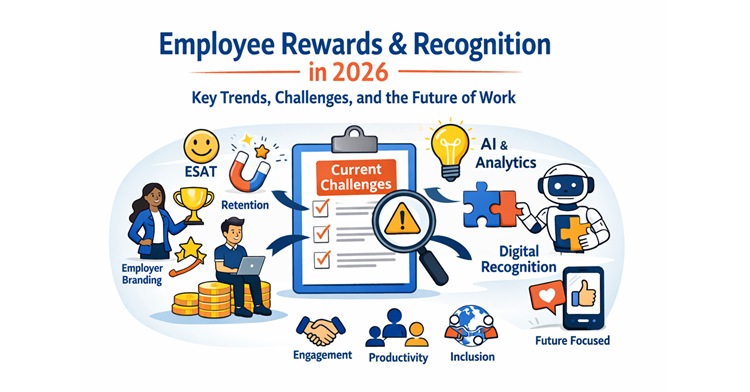
Key Trends, Challenges, and the Future of Work
By 2026, employee rewards and recognition will shift from isolated programs to embedded organizational infrastructure, shaping employees’ daily work experience.
1. Recognition is entering a breakout growth phase driven by talent scarcity, hybrid work, digital transformation, and rising employee expectations.
2. Digital-first recognition is becoming the default, replacing manual, ad-hoc, and offline models.
3. Recognition is shifting from annual events to continuous experiences embedded into daily work.
4. Inclusion is becoming non-negotiable, with frontline, deskless, gig, and remote workers fully integrated into R&R programs.
5. Social and peer-to-peer recognition will drive culture, belonging, and collaboration.
6. Recognition will be embedded into everyday workflows via platforms such as Teams, Slack, WhatsApp, and HRMS systems.
7. AI will personalize recognition at scale, improving fairness, relevance, and impact.
8. Leadership will demand measurable ROI, linking recognition directly to engagement, retention, productivity, and performance.
9. R&R will evolve into a strategic people infrastructure rather than a standalone HR program.
Organizations that treat recognition as a strategic business capability will build stronger cultures, retain better talent, and outperform competitors. Those who delay will struggle with engagement, differentiation, and workforce resilience in the future of work.

Employee rewards and recognition (R&R) is no longer a “nice-to-have” HR initiative.
As organizations navigate talent shortages, evolving workforce expectations, AI-driven workplaces, and distributed teams, recognition has become a strategic lever for performance, culture, and employer branding.
To understand how this space is evolving, HiFives conducted an in-depth study of 500+ HR leaders and managers across industries, organization sizes, and maturity levels.
The objective was to answer the following questions:
1. Why will employee recognition enter a breakout growth phase in 2026?
2. What are the Key Trends shaping Employee Rewards and Recognition in 2026?
3. What benefits are organizations expecting from rewards and recognition in 2026?
4. Why are so many organizations still struggling with rewards and recognition? What challenges are they facing?
5. What are the Levels of Rewards and Recognition Maturity of Organizations?
Here, we distil the findings into actionable insights for HR leaders and managers preparing for the next phase of work.

The last decade reshaped how employees perceive work. Compensation alone is no longer a sufficient motivator. Employees expect appreciation, fairness, visibility, and purpose.
Employee recognition is no longer a soft HR initiative. It has become a measurable, strategic driver of talent outcomes.
Recognition is increasingly viewed as the operating system of culture rather than a periodic HR activity.
It makes values visible, reinforces desired behaviors, and creates emotional connection, especially in hybrid and remote environments where informal appreciation is harder to replicate.
As part of the HiFives research study, we analyzed what is truly accelerating the growth of employee rewards and recognition programs in India and other emerging economies.
The findings were clear and consistent.
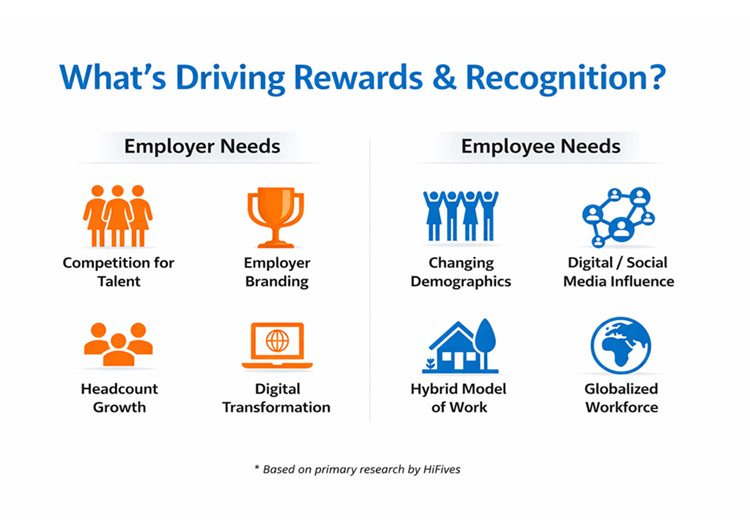
1. Competition for skilled talent is intensifying, making differentiation beyond compensation critical.
2. Employer branding is now being shaped by real employee experiences, not by polished corporate narratives.
3. Rapid headcount growth and geographic spread are breaking the manual and ad-hoc recognition approaches while scaling.
4. Digital transformation is creating an expectation of anywhere, anytime, data-backed HR systems.
1. A younger, more diverse workforce expects more frequent, visible appreciation.
2. Social and digital behaviors have normalized instant acknowledgment.
3. Hybrid work models have made digital recognition essential for connection and belonging.
4. Global teams require inclusive, flexible, and localized recognition programs.
Based on insights from this study, HiFives projects a 15% CAGR in the usage of digital employee recognition in India and other emerging markets over the next five years.
This growth isn’t aspirational. It’s structural. Recognition is moving from the sidelines of HR policies into the core of people strategy, directly influencing engagement, retention, and employer branding.
For HR leaders, the real shift is that the conversation is no longer about whether to invest in employee rewards and recognition, but about how it is strategically aligned with the organizational goals and culture, embedded in the daily flow of work, and measured for impact.

Employee Rewards and Recognition is no longer an HR initiative. It’s becoming a core business strategy. Insights from recent HiFives research, combined with broader signals from the HR ecosystem, point to a fundamental shift in how organizations design, deliver, and measure recognition.
By 2026, R&R will move from being transactional and program-based to being digital, continuous, inclusive, intelligent, and ROI-driven.
Here are the defining trends shaping the future of employee recognition:
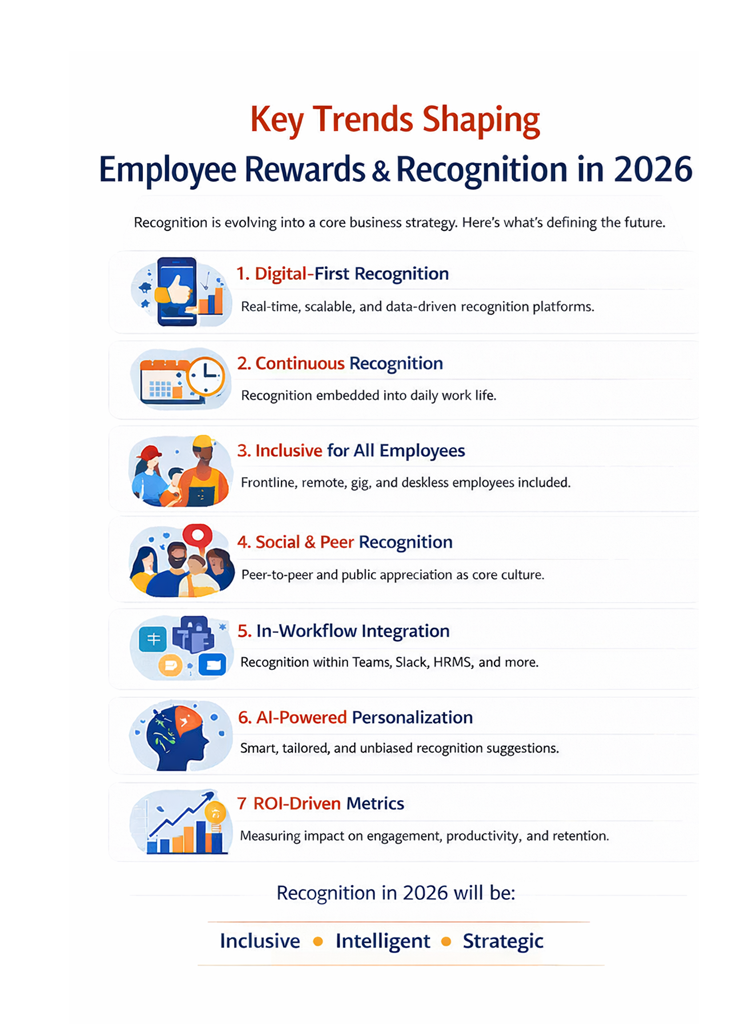
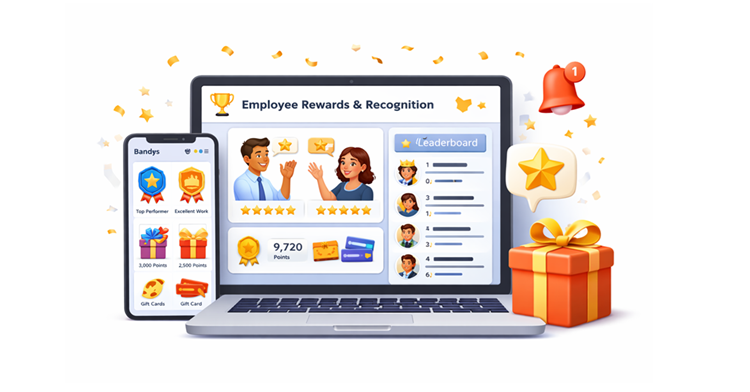
Recognition will no longer depend on managers remembering to appreciate employees. Organizations will move from ad-hoc appreciation to structured, digital-first recognition ecosystems.
Digital platforms will:
1. Enable real-time recognition
2. Standardize recognition across teams and locations
3. Align appreciation with values and behaviors
4. Gamifying activities under key performance areas (KPAs)
5. Create data trails for analytics and insights
6. Make recognition visible, measurable, and scalable
What this means:
Recognition becomes a system, not a sentiment. Organizations will treat it like any other strategic digital infrastructure.

The era of once-a-year awards is ending. In 2026, recognition becomes embedded in everyday work life.
Shifting from:
1. Annual ceremonies
2. Quarterly awards
3. Periodic recognition events
Organizations will adopt:
1. Moment-based/ Spot recognition
2. Micro-appreciation
3. Contextual recognition tied to real work events
4. Real-time celebration of wins, effort, learning, and impact
What this means:
Recognition becomes a daily experience, not an annual event. It shifts from episodic to continuous.
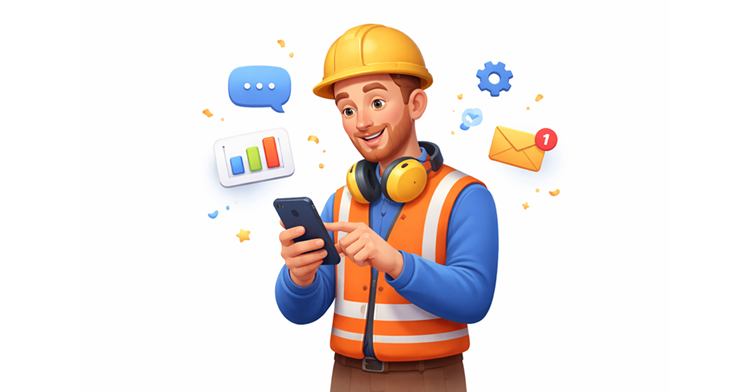
Organizations will build future R&R strategies for the entire workforce, not just corporate employees.
Recognition will actively include:
1. Frontline staff
2. Factory and shop-floor workers
3. Field sales and service teams
4. Gig and contract workers
5. Remote employees
6. Blue-collar and deskless workers
Technology will enable access through:
1. Mobile-first platforms
2. WhatsApp-based recognition
3. Simple, multi-lingual interface for non-desk employees
4. LED displays to showcase award winners
What this means:
Recognition becomes universal, not hierarchical. Everyone participates. No one is invisible.

Recognition will become social by design.
Includes:
1. Peer-to-peer recognition as a core pillar
2. Org-wide visibility of appreciation
3. Public recognition feeds
4. Team-based recognition moments
5. Cross-functional appreciation
6. Community-driven celebration
Social recognition creates:
1. Cultural alignment
2. Emotional connection
3. Psychological safety
4. Belonging
5. Collaboration
What this means:
Recognition stops being a top-down activity and becomes a cultural behavior.
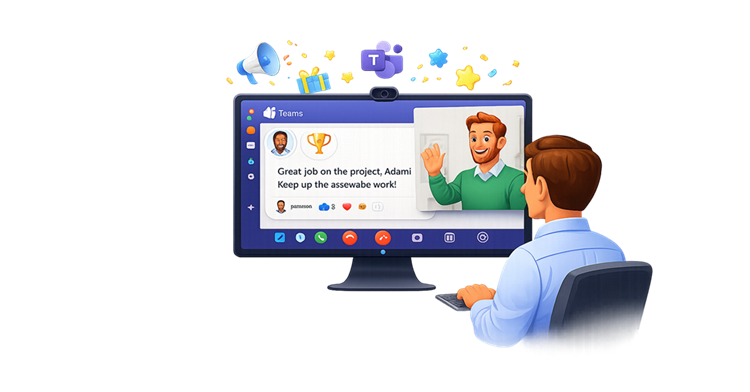
Employees won’t go to a separate portal to recognize someone.
Recognition will live inside:
1. Microsoft Teams
2. Slack
3. WhatsApp
4. HRMS platforms
5. OKR tools
6. Project management tools
It becomes part of daily workflows, not an additional task.
What this means:
Recognition becomes frictionless. It fits with how people already work, rather than asking them to change behavior.
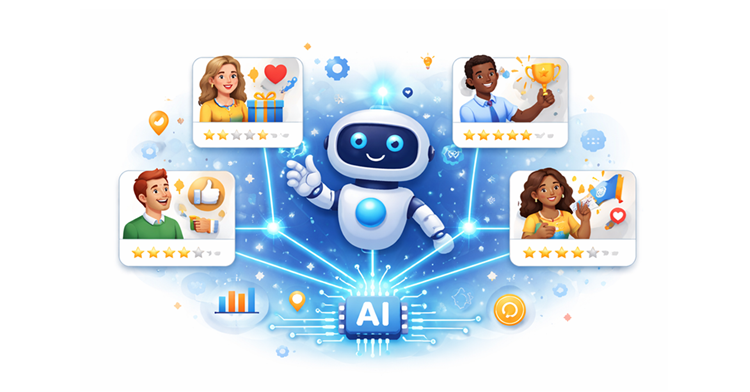
AI will transform recognition from generic to intelligent.
AI-powered systems will:
1. Recommend whom to recognize
2. Suggest the right moment to recognize
3. Personalize recognition messages
4. Detect recognition gaps
5. Identify invisible contributors
6. Prevent bias and favoritism
7. Suggest meaningful rewards
8. Align recognition with outcomes and behaviors
What this means:
Recognition becomes smart, fair, contextual, and personalized at scale.
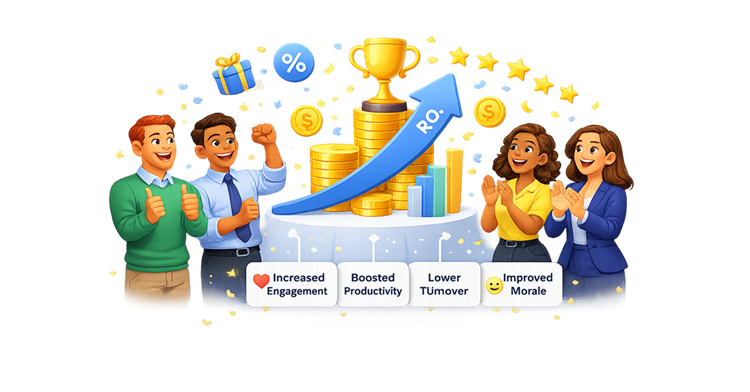
Leadership will demand a clear linkage with core business metrics.
Recognition programs will be expected to show clear links to:
1. Employee Satisfaction
2. Productivity
3. Performance
4. Engagement
5. Innovation
6. Culture
7. Retention
8. Employer branding
R&R will be measured like any other business investment.
Recognition platforms need to measure and track:
1. Recognition frequency
2. Recognition coverage
3. Participation rates
4. Cultural alignment
5. Performance correlation
6. Business impact
What this means:
Recognition moves from “feel-good HR initiative” to strategic business lever.
One of the strongest signals from the HiFives study was alignment across industries and organization sizes. Regardless of maturity, most organizations agree on what they want their R&R programs to achieve.
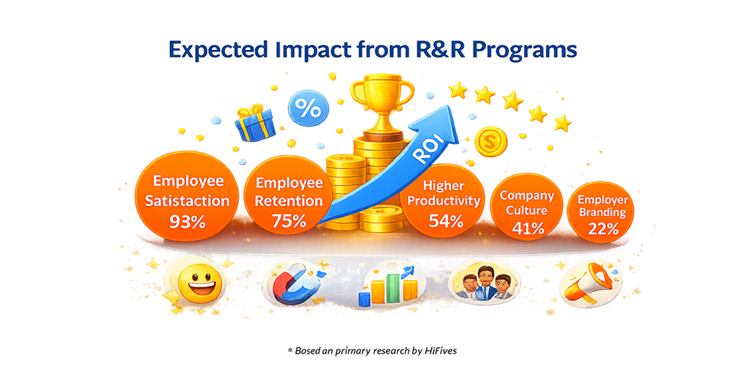
1. 93% link R&R directly to higher employee satisfaction
2. 75% see it as a driver of retention
3. 54% connect it to productivity gains
4. 41% use it to strengthen company culture
5. 22% leverage it to build an employer brand
Here are the top expected benefits from employee rewards and recognition in 2026:
| Expected Benefits | Why It Matters in 2026 |
| 1. Higher employee satisfaction (ESAT Scores, GPTW Rankings, etc.) | Direct correlation with engagement, advocacy, and discretionary effort |
| 2. Improved retention, especially of top talent | High performers seek environments where contributions are visible |
| 3. Increased productivity | Recognition reinforces behaviors that drive outcomes |
| 4. Stronger company culture | Shared values become visible through recognition moments |
| 5. Enhanced employer branding | Authentic recognition stories attract future talent |
Key Insights
Interestingly, expectations were consistent regardless of whether organizations already had R&R programs, used offline processes, or deployed digital platforms. The aspiration is universal. The execution maturity is not.
Despite the proven impact of recognition on engagement, retention, and performance, HiFives’ primary research shows that adoption remains slower than expected. Here’s what’s really holding organizations back:
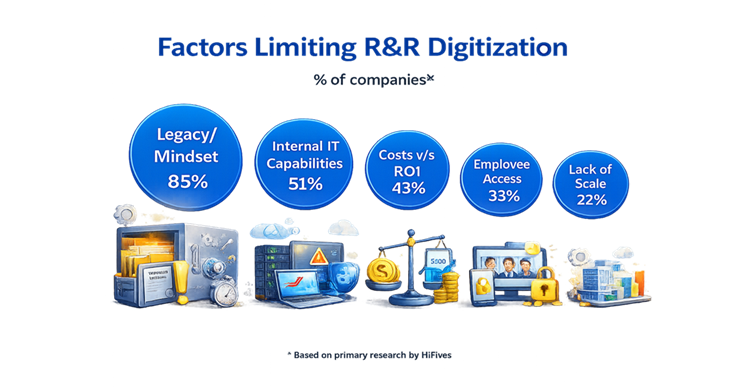
1. Legacy Mindsets: Recognition is still treated as “nice to have” rather than a strategic lever for culture and performance.
2. Limited Internal IT Capabilities: R&R is often deprioritized against core systems, even though modern platforms integrate seamlessly.
3. Cost vs ROI Concerns: When impact isn’t measured, business leaders see recognition as an expense instead of a growth driver, and also, concerns about high digitization costs.
4. Poor Last-mile Employee Access: If frontline and distributed teams can’t easily access recognition, participation collapses.
5. Perceived Lack of Scale: Smaller or complex organizations assume they don’t need digitization – when in reality, consistency and fairness matter most at scale.
To understand challenges and future trends, HiFives classified organizations into four segments based on the maturity levels of their employee rewards and recognition:
1. No formal R&R programs
2. Offline R&R programs
3. Low-tech or poorly integrated R&R systems
4. Full-scale digital R&R platforms
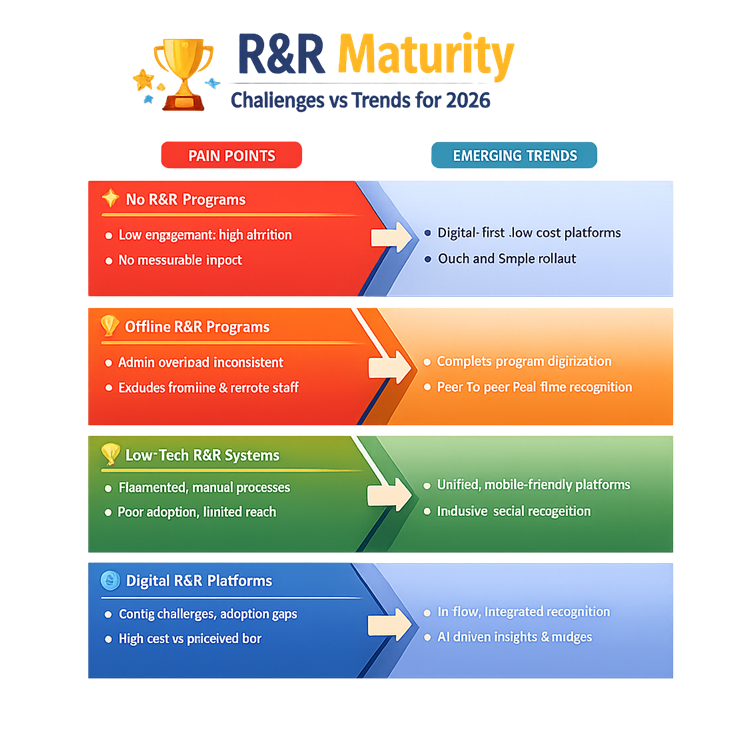
Each segment faces distinct realities and opportunities.
Who They Are
1. Smaller organizations
2. Traditional or family-run enterprises
3. Companies in manufacturing, logistics, etc., are heavy on blue-collar employees
4. Companies with limited IT readiness
4. Organizations with legacy HR mindsets
Current Pain Points
Without recognition, feedback tends to be transactional and delayed, weakening emotional connection with the workplace.
1. Missing measurable ROI from recognition-driven engagement
2. Lower morale and engagement scores
3. Difficulty attracting skilled talent in competitive markets
4. Higher attrition due to a lack of appreciation
Without recognition, performance feedback becomes transactional and delayed, reducing emotional connection with the organization.
Emerging Trends
Interestingly, these organizations are not looking for incremental improvements. They want to leapfrog.
1. Digital-first recognition models from day one
2. Low-cost, easy-to-use, and quick-to-deploy solutions
3. Simple, intuitive tools requiring minimal training
4. Faster rollout without heavy HR dependency
Outlook for 2026
By 2026, most organizations in this segment are expected to bypass offline recognition altogether and adopt lightweight digital recognition tools designed for speed and simplicity.

Who They Are
It is the largest segment across industries.
1. Mid-sized to large enterprises
2. Manufacturing, financial services, pharma, infrastructure
3. Organizations relying on annual awards, certificates, trophies, and town halls
Current Pain Points
While well-intentioned, offline programs create several challenges.
1. Heavy administrative burden on HR teams
2. Limited and inconsistent employee experience
3. Difficulty scaling as headcount grows
4. Challenges operating across locations and shifts
5. No real-time data on program effectiveness
6. Often excludes remote or frontline employees.
Emerging Trends
1. Complete digitization of R&R programs
2. Multi-channel recognition to reach all employee segments
3. Peer-to-peer and spot recognition replacing annual-only awards
4. Real-time recognition embedded in daily workflows
Outlook for 2026
By 2026, offline recognition models are expected to decline rapidly, as they are replaced by continuous, inclusive digital experiences.

Who They Are
Many organizations fall into a middle ground where recognition is partially digitized.
1. Companies using in-house tools
2. Using HRMS-based recognition modules
3. Using Google Forms and email-driven processes
4. Partial digitization of nominations or rewards
Current Pain Points
Despite the presence of technology, there are several challenges that these organizations face:
1. Fragmented processes across multiple systems
2. High manual intervention despite “digital” tools
3. Non-inclusive programs favoring desk-based employees
4. Poor user experience leading to low adoption
5. Leadership questioning ROI and effectiveness
Technology exists, but it does not work cohesively.
Emerging Trends
The trend here is clear. These organizations are looking to move beyond basic digitization toward integrated, purpose-built recognition platforms.
1. Inclusive programs covering frontline and blue-collar workers
2. Social recognition feeds to amplify engagement
3. Mobile-first access
4. Global-ready platforms supporting multi-country teams
Outlook for 2026
By 2026, fragmented R&R solutions are likely to be phased out in favor of cohesive digital recognition platforms that streamline the entire process and deliver consistent experiences.

Who They Are
Organizations at the highest maturity level typically use enterprise-grade recognition platforms such as HiFives, Vantage Circle, Xoxoday, and Advantage Club.
1. Enterprises using digital recognition platforms
2. Companies with formal recognition policies and budgets
3. Organizations prioritizing employee experience
Current Pain Points
1. Limited configurability for complex policies
2. Adoption gaps despite platform availability
3. Perceived high costs relative to outcomes
4. Over-reliance on HR teams to drive participation
Emerging Trends
The next phase of evolution focuses on removing friction rather than adding features.
1. In-flow recognition embedded into daily tools
2. Deep integrations with collaboration platforms
3. AI-driven nudges to drive manager participation
4. Advanced analytics to optimize recognition strategies
5. Agentic AI to automate workflows, reminders, and insights
Outlook for 2026
By 2026, organizations will shift towards digital R&R platforms as intelligent, deeply integrated, and comprehensive tools rather than standalone HR tools.

Recognition is entering a breakout growth phase driven by talent shortages, hybrid work models, digital transformation, rising employee expectations, and a shift toward experience-driven employer branding. HiFives’ research also projects a 15% CAGR in the adoption of digital recognition across India and emerging markets.
Key R&R trends in 2026 include:
1. Digital-first recognition platforms
2. Continuous, moment-based recognition
3. Inclusive recognition for frontline and deskless workers
4. Social and peer-to-peer recognition
5. Embedded recognition in daily workflows (Teams, Slack, WhatsApp)
6. AI-driven personalization and fairness
7. ROI-driven recognition strategies
Organizations expect recognition programs to deliver:
1. Higher employee satisfaction
2. Improved retention
3. Increased productivity
4. Stronger company culture
5. Better engagement
6. Enhanced employer branding
7. Improved talent attraction
By 2026, recognition platforms will be intelligent, AI-powered, deeply integrated, analytics-driven, mobile-first, inclusive, and workflow-embedded systems that function as strategic people infrastructure rather than standalone HR tools.
Organizations should:
1. Shift to digital-first platforms
2. Build continuous recognition, models
3. Include all workforce segments
4. Embed recognition into workflows
5. Use AI for personalization
6. Measure ROI and business impact
7. Align recognition with culture and strategy
The HiFives study reinforces a powerful truth: Organizations may differ in maturity, but they share the same goals – engaged, motivated, and loyal employees.
By 2026, employee recognition will no longer be an HR initiative – it will be organizational infrastructure.
It will live inside daily workflows, shape culture in real time, influence performance outcomes, and directly impact retention, engagement, and employer branding.
Recognition is moving from programs to platforms, from moments to systems, from sentiment to strategy.
HR leaders who treat recognition as a core business capability will build stronger cultures, higher-performing teams, and more resilient organizations. Those who delay will face rising disengagement, weaker employer brands, and growing talent risk.
The future of work will reward organizations that consistently, intelligently, and at scale recognize people. Recognition is no longer optional. It is strategic!

Lead author: Sagar Chaudhuri, the Co-Founder and CEO of HiFives. He is an HR Tech Evangelist with over 25 years of experience in both corporate and entrepreneurial settings. Previously, Sagar has held leadership roles with companies such as Genpact, Infosys, and ICICI Bank. He has an engineering degree from IIT Kharagpur and an MBA from IIM Lucknow. Connect on LinkedIn
To stay updated on the latest HiFives blogs, follow us on Twitter (@MyHiFives)