

These trends in employee recognition can help organizations develop the roadmap for changes they need to make to their recognition programs.
1. The emerging trends in employee recognition for 2024 include the increasing use of AI/ML for personalized and unbiased recognition, AR/VR for immersive experiences, and omnichannel recognition integrated into workplace software.
2. Another significant aspect of this trend is the growing role of chatbots and other AI-powered tools in facilitating instant and multilingual recognition, demonstrating their practical application in the workplace.
3. These trends, driven by technological advancements and changing workforce dynamics, aim to enhance employee motivation and engagement in the evolving work environment.
Over the past few years, employee recognition has become increasingly important. At the same time, new trends in employee recognition have significantly impacted the practices, processes, and outcomes of recognition programs.

Many factors, including evolving business practices, changes in socioeconomic conditions, and emerging market trends, significantly impact employees’ recognition and expectations.
Hence, organizations today need to keep an eye on these emerging trends to ensure that their employee rewards and recognition programs remain relevant and effective.
Therefore, incorporating these changes into recognition programs is essential to achieving the desired employee motivation and engagement.

Check out the earlier articles:
– 2023 Employee Recognition Trends
– 2022 Employee Recognition Trends
– 2021 Employee Recognition Trends
– 2020 Employee Recognition Trends
Awareness of these trends can enable organizations to modify their recognition programs promptly.
Hence, it can provide them with a competitive advantage in retaining top talent and boosting the confidence and morale of their workforce.
Most importantly, organizations can maintain the relevance and effectiveness of their recognition programs by making minor adjustments to align with emerging trends.

Organizations need to understand employee recognition trends to keep their programs in sync.
Before that, it is important to learn about the various factors that are potentially driving these trends.
Hence, organizations can more easily establish long-term trends and assess whether they need to adjust their recognition programs.
So, here are the factors that are driving new trends in employee recognition:
1. Emerging Technologies
2. New Operating Models
3. Workforce Dynamics
4. Macroeconomic Factors
5. Need For Deep Personalization
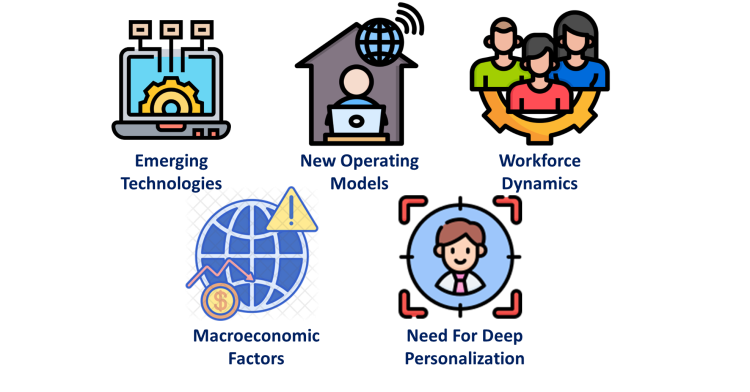

Emerging technologies such as AI/ ML and VR/ AR. are the major factors driving new recognition trends.
These technological advances can enable instant recognition, even for remote workers.
Additionally, these technologies can enhance the user experience in employee recognition programs, making them more impactful and engaging for the entire workforce.

Over the past few years, most organizations have adopted new work models, including hybrid and remote working.
These new operating models have disrupted the normal mode of working from a physical workplace.
Hence, it is unsurprising that traditional recognition methods are not proving as effective under these new conditions.
This new work environment requires new recognition methods and more effective and satisfying employee strategies.

Employee dynamics in organizations are among the most significant drivers of new recognition trends.
Often, younger employees prefer recognition methods with better experiences, whereas older ones opt for recognition practices promising greater material benefits.
Similarly, employees working in different regions and countries with different socio-cultural backgrounds have different recognition needs.
Thus, the uniqueness of each employee cohort within the organization is vital to driving new recognition trends.

Also, the changing macroeconomic environment in different countries and regions worldwide significantly drives new recognition trends.
Inflation levels, interest rates, growth or recessionary trends, exchange rates, etc. have a direct and indirect impact on the financial well-being of employees.
Hence, it may influence employees’ recognition needs and expectations.

Your employees, yes, especially millennials and Gen Z, prefer personalized recognition. Personalized recognition ensures employees feel valued as individuals and fosters a sense of belonging.
This requires organizations to incorporate the individual employees’ likes and dislikes into the recognition process.
Significant changes in the business environment, technology, operating models, employee dynamics, and macroeconomics influence employee recognition trends.
Understanding these trends is critical for organizations so that they can incorporate them into their employee recognition programs.
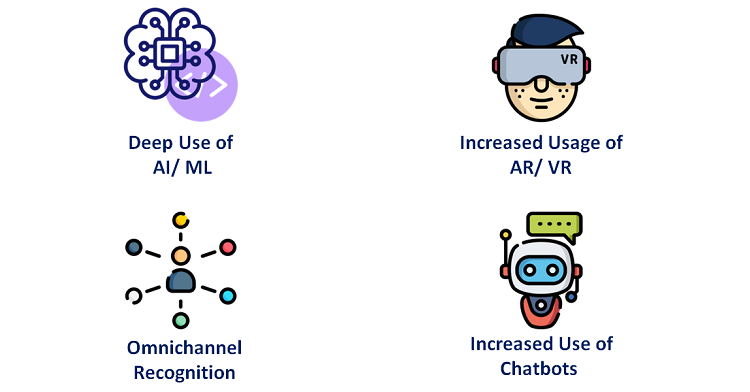
Here are the top employee recognition trends for 2024 that organizations should look out for:
1. Deep Use of AI/ ML for Recognition
2. Increased Usage of AR/ VR in Recognition
3. Omnichannel Recognition/ Deep Integration
4. Increased Use of Chatbots
In 2024, organizations are likely to use AI/ML extensively to enhance recognition processes and make them more impactful. It is more likely to complement rather than replace human actions.
AI/ ML can provide deep insights into employee performance and help deliver better targeted and more personalized recognition.
Here are a few ways in which AI/ ML can enhance employee recognition:
A. Targeted Recognition
B. Real-time Alerts and Nudges
C. Eliminates Bias and Favoritism
D. Personalized Recognition
E. Sentiment Analysis
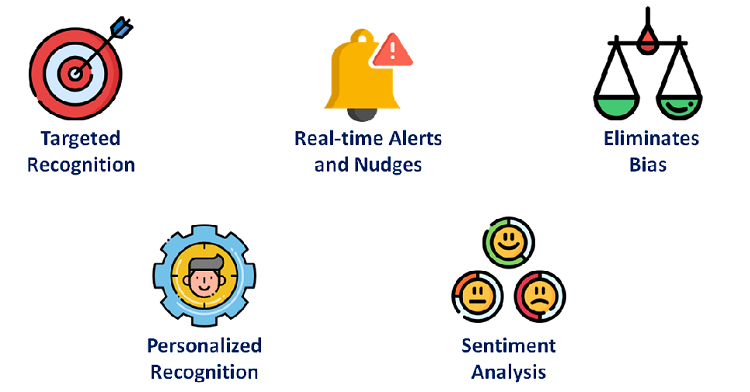

AI/ML can help organizations analyze employee data and provide valuable insights into their work performance.
These algorithms can scan massive amounts of employee performance data, including project completion, sales figures, learning milestones, and customer feedback.
They can identify patterns and correlations that may not be apparent through manual analysis, helping in better-targeted recognition.

AI-powered systems can give managers and HR real-time nudges and alerts when employees achieve milestones or demonstrate exceptional performance.
So, it can enable timely recognition and reinforce positive behavior without waiting for a formal review cycle.

Additionally, AI/ML can help make the recognition process more transparent and eliminate bias and favoritism.
These algorithms can automatically review recognition requests by managers and decide to approve or reject them in real time based on analysis of the available data.
It can also flag off potentially incorrect decisions to the program administrators.

AI can help personalize recognition methods based on individual preferences and employees’ work.
It can recommend rewards or recognition gestures such as awards, bonuses, or public praise, that are most meaningful to each employee based on their past preferences and feedback.
It can personalize the recognition messages accordingly.

AI-driven natural language processing (NLP) to analyze employee internal communication, survey responses, and posts on collaboration platforms like Slack and Teams to identify patterns and sentiments.
This can be used to analyze employee behaviors about the organization’s core values. Thus, it can help the organization tailor recognition efforts accordingly.
Such use cases are making AI/ M popular in employee recognition programs.
Several organizations have already incorporated them in their recognition programs on a smaller scale, with plans to expand their scope in 2024.
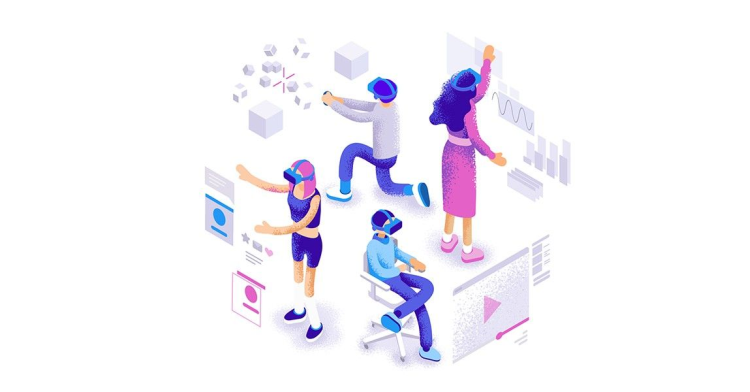
Augmented reality (AR) and virtual reality (VR) can help employees experience immersive, engaging recognition.
These technologies can be quite effective in fostering a positive work environment and celebrating the contributions of employees irrespective of where they are located.
Here are a few use cases for AR/ VR in employee recognition programs:
A. Virtual Recognition Ceremonies
B. Virtual Rewards and Trophies
C. Immersive Employee Stories
D. Gamified Recognition
E. VR Recognition Cards and Messages
F. VR Experiences as Rewards
G. Customized VR Workspaces as Rewards
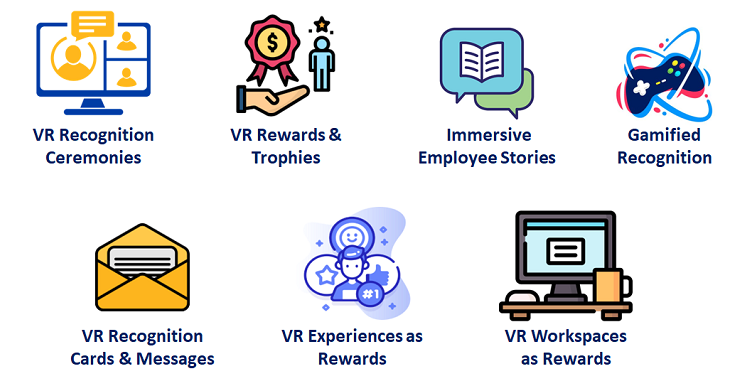

VR can host virtual recognition ceremonies or events where employees can gather digitally to celebrate achievements and milestones.
This can enable a more immersive and inclusive experience, especially for remote-working or geographically dispersed teams.
AR can enhance virtual team meetings by overlaying recognition messages, achievements, or virtual awards onto participants’ video feeds, making recognition part of regular work interactions.

Organizations can use VR to reward employees with virtual trophies, badges, or other digital rewards instead of traditional physical merchandise.
When displayed in their virtual workspaces, these virtual rewards would constantly remind them of their achievements and motivate them for a long time.
AR/VR can create immersive storytelling experiences that showcase the inspirational journeys and accomplishments of employees receiving recognition.
These interactive narratives can enable co-workers to get a deeper understanding and appreciation of their peers’ contributions and feel inspired to emulate them.

VR environments can gamify recognition programs by creating interactive games and challenges related to employee achievements.
It can make recognition more engaging and enjoyable for employees.

Instead of sending traditional recognition cards, managers and colleagues can send personalized VR cards or messages that the recipient can view in a virtual environment.
Generative AI can create customized and personalized designs for these recognition cards on the fly.

Employees can be offered VR experiences as rewards. For example, they can be given VR headsets with pre-loaded virtual adventures or personal messages from the CEO.
These can be memorable ways to acknowledge their contributions. Also, organizations can offer recognized employees VR mentorship, coaching, or team-building sessions.

Some organizations are already experimenting with customized VR workspaces for employees.
Recognized employees could receive special VR office spaces or other VR facilities that reflect their achievements and personal interests.
Integrating AR/VR with employee recognition software can create immersive experiences that boost motivation and make employees feel more connected to their organization.

Another important trend that organizations need to look out for in 2024 is embedding recognition features in the existing software platforms used at the workplace or through deep integration with them.
It can make the recognition process seamless and timely by enabling managers and co-workers to recognize their team members from any workplace platform.
A. Embedding Recognition Features in Other Platforms
B. Automated Recognition triggered from Other Platforms

Embedding recognition features into communication and collaboration tools, project management software, and sales systems can improve the recognition process.
It will also make it easier for employees to send and receive recognition, leaving the current platform.
For example, a project manager can instantly recognize a team member who has just completed a significant project activity on the project management tool itself.
The employee receives the notification through the tool and recognition is also showcased to other team members on the tool itself.

In addition to recognition features on other platforms, organizations can integrate them with their existing recognition platforms to seamlessly embed recognition into workflows.
Integration with the recognition platform could trigger automated recognition when employees complete certain activities within their work systems.
For example, when an employee completes a certain training module or assessment in the learning management system (LMS), it would automatically trigger a reward or recognition to the employee through the integration with the recognition platform.
Similarly, whenever a customer service employee gets a 5-star customer rating, it would immediately trigger a reward in the recognition platform through an
integration with the CRM tool.
Such integration would eliminate the need for manual intervention by managers or HR. These triggers could be based on predefined rules and occur instantaneously.
Hence, help foster a culture of recognition and create a more positive, motivating work environment.

Chatbots powered by AI and NLP are gaining significant popularity in the workplace. They can enhance their recognition processes.
Bots can make the recognition process extremely easy and conversational, enhancing employee experience and engagement.
Hence, they can be used in employee recognition programs to automate and enhance different aspects of the recognition process, making it more efficient, scalable, and engaging.
So, here are a few ways in which organizations can use bots for employee recognition:
A. Automated Recognition Alerts/ Nudges
B. Peer-to-Peer Recognition
C. Instant Recognition
D. Customized Recognition Messages
E. Multi-Language Recognition
F. Feedback through Chatbots
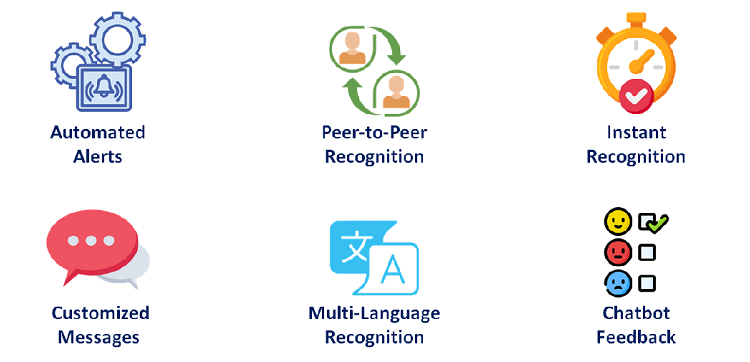

Bots can send automated alerts or nudges to managers and team members to recognize employees for their achievements, milestones, or exceptional performance.
Additionally, they can recommend specific recognition actions based on an employee’s accomplishments and contributions.
For instance, if an employee has successfully completed a project, the bot can recommend sending him/ her a personalized ‘thank-you; message or nominating them for an award.

Bots can facilitate peer-to-peer recognition by providing a platform where employees can easily acknowledge their co-workers’ contributions.
These bots can then share the recognition messages publicly or privately, depending on employee preferences.

Bots can facilitate instant recognition by enabling managers and co-workers to send quick ‘thank-you’ messages and appreciation e-cards to their colleagues, promoting a culture of continuous appreciation.
Bots can analyze employee data to identify and recognize outstanding performance, work anniversaries, or other milestones automatically.
They can also send automated recognition messages to employees based on their achievements.
Additionally, organizations can customize these messages to the individual’s role and preferences.
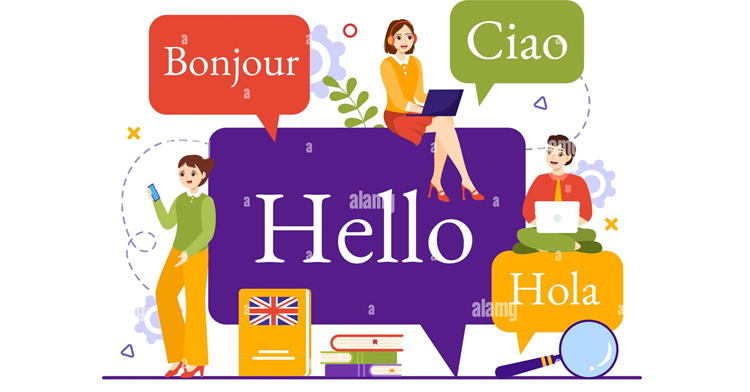
For multinational companies, bots can automatically translate recognition messages into employees’ preferences and ensure that employees from different language backgrounds can easily participate in recognition programs.
Chatbots can collect employee feedback on their experience with the recognition program. This data can be valuable for refining and improving the recognition program.
Implementing bots for employee recognition can help organizations make the system user-friendly and responsive.
It can make the entire recognition process simple, seamless, and engaging for the employees.
Learn about the Top Employee Rewards and Recognition Trends in 2025 and Beyond
Understanding the above trends in employee recognition can help organizations develop roadmaps for their recognition programs to enhance their effectiveness in 2024 and beyond.

Lead author: Sagar Chaudhuri, the Co-Founder and CEO of HiFives. He is an HR Tech Evangelist with over 25 years of experience in both corporate and entrepreneurial settings. Previously, Sagar has held leadership roles at companies such as Genpact, Infosys, and ICICI Bank. He has an engineering degree from IIT Kharagpur and an MBA from IIM Lucknow. Connect on LinkedIn
To stay updated on the latest HiFives blogs, follow us on Twitter (@MyHiFives)