


Mindfulness can be an effective way to create a low-stress, highly productive, and positive work environment.
What is Mindfulness?
Mindfulness is the practice of being fully aware and present in the moment without judgment. It involves heightened self-awareness and attention to one’s surroundings, promoting a calm and focused mindset.
Benefits to Organizations:
Mindfulness can reduce employee stress, burnout, and absenteeism, improving overall well-being and productivity. It fosters better workplace relationships, enhances communication and collaboration, and supports a culture of innovation by encouraging open-mindedness and adaptability.
Best Practices for Promoting Mindfulness:
Organizations should build awareness through effective communication, conduct online and offline workshops, identify mindfulness champions, involve top management in leading by example, and optimize meeting practices to reduce stress and enhance focus.
Want a rewards program your employees actually love?
See how leading companies use HiFives to boost engagement, retention and productivity.
Book a Free DemoChat on WhatsAppAccording to a ‘Health at Work’ survey, about 80% of employees reported being stressed at work and needing help managing it. A practical solution to this is mindfulness at work. More and more organizations across the globe are now focusing on and promoting mindfulness in their workplaces.

Simply put, mindfulness is being aware, paying attention to the present moment, and refraining from judging.
Interestingly, this concept has its roots in Buddhist literature and fosters heightened awareness of oneself and the surrounding environment.

From Google to General Mills to NHS; many organizations are preaching and practicing mindfulness at work.
Harvard School of Business has even included mindfulness principles in its curriculum for the leadership programs.
Therefore, the importance of mindfulness has only grown with the onset of the COVID-19 Pandemic and the consequent shift to remote working.
Practicing mindfulness benefits not only individual employees but also the entire workplace. Why should mindfulness be practiced at the workplace?

Organizations are focusing more and investing more in their employees’ well-being, given the increased costs of an unhealthy workforce.
These costs can range from poor productivity, high absenteeism, and even high turnover.
Therefore, organizations offer mindfulness training to help employees respond positively in difficult situations and avoid burnout, work stress, and appraisal issues.

Mindfulness at work helps in reducing stress, which is a dominant cause of employee disengagement and low productivity.
Hence, to address this, prominent companies such as Google, Goldman Sachs, Adobe, and the Mayo Clinic have launched mindfulness programs to promote employee engagement and reduce stress.

The cornerstone for employee happiness is the healthy working relationship among peers.
Hence, this is particularly important at this time of hybrid working, which is stressful for employees and their supervisors.
Also, employees can open their minds to absorb new information by taking a break from critical thinking or problem-solving.
Hence, organizations now offer mandatory leave to help employees avoid excessive stress and stagnant thinking.
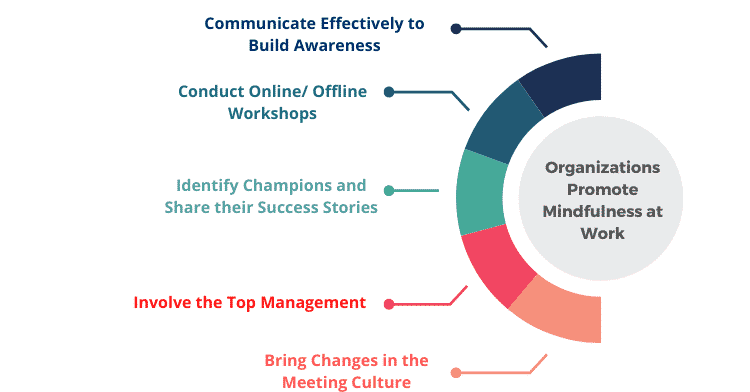
Here are a few ways how organizations can promote the practice of mindfulness at work:
1. Communicate Effectively to Build Awareness
2. Conduct Online/ Offline Workshops
3. Identify Champions and Share Their Success Stories
4. Involve the Top Management
5. Bring Changes in the Meeting Culture

Initially, organizations should run online and offline campaigns to build awareness about practicing mindfulness and communicate its benefits.
Therefore, they should design these campaigns thoughtfully with images, videos, and infographics.
Digital platforms such as emails, intranet, Teams/ Slack channels, WhatsApp groups, etc. should be used effectively to communicate the importance of mindfulness.
Organizations can supplement this with posters, standees, tent cards, LED displays, and other materials to reinforce the message for employees in the office.

Additionally, the organization should engage experts to train employees in mindfulness practices.
The organization can also bring in celebrity trainers if budgets permit to generate greater employee interest.
The organization should also conduct training sessions virtually through video conferencing platforms for the benefit of those employees who are working from home.
They should also record these sessions and make them available on the intranet or, if one exists, on the employee wellness portal.
Also, the organization should conduct offline sessions for in-office employees, with appropriate COVID-related precautions.

The organization should appoint employees who demonstrate a strong interest in and involvement with mindfulness practice as champions or ambassadors.
Hence, organizations should encourage them to share their success stories on various digital platforms within the organization.
Therefore, such positive experiences will likely inspire other employees to practice mindfulness.

Also, it is best to start at the top by roping in the top management to practice and preach mindfulness.
Mindfulness coaches/ experts can conduct personalized sessions for them.
The top management should not just practice mindfulness themselves but also promote it within the workforce in every possible forum.
They should share their personal experiences and the benefits that they have received.

Additionally, meetings can be a great source of stress, anxiety, and restlessness for employees.
Therefore, organizations should aim to increase the productivity of internal meetings by making them shorter, time-bound, agenda-driven, and limited only to participants who can add value to the meeting.
Hence, organizations should train their managers and team leaders to manage meetings effectively and to turn them into ideal forums for practicing mindfulness.
Mindfulness at work is an effective way to create a low-stress, highly productive, and positive work environment. Hence, organizations need to effectively promote its practice among the workforce.

Lead author: Sagar Chaudhuri, the Co-Founder and CEO of HiFives. He is an HR Tech Evangelist with over 25 years of corporate and entrepreneurship experience. In the past, Sagar has held leadership roles at companies such as Genpact, Infosys, and ICICI Bank. He has an engineering degree from IIT Kharagpur and an MBA from IIM Lucknow. Connect on LinkedIn
To stay updated on the latest HiFives blogs, follow us on Twitter (@MyHiFives)
Ready to transform employee recognition at your company?
See how leading companies use HiFives to boost engagement, retention and productivity.
Book a Free DemoChat on WhatsApp